Termite Fumigation Services 2026 Cost and Safety Guide
Fumigation services seal a home, warehouse or shipping container and fill it with a gas that kills pests hiding where sprays cannot reach. Licensed professionals use them mostly for drywood termites, severe indoor infestations and cargo that must meet import rules.
That sounds dramatic because it is. A typical home job means leaving your house for several days, bagging your food and paying roughly $2,000 to $8,000. This guide shows how the process works, what drives the price, where the real risks sit and how to tell whether you need fumigation at all or whether a cheaper treatment will do the job.
Every factual claim here comes from regulators, university entomologists or published provider information, and the sources are listed at the end.
Quick Answers
| Question | Short answer |
| What do fumigation services treat? | Drywood termites, severe bed bug and wood boring beetle cases, stored product pests in warehouses, and cargo or wood packaging that must meet import rules. |
| How much do they cost? | HomeGuide puts tent fumigation at $1 to $4 per square foot, which works out to $2,000 to $8,000 for an average sized home. |
| How long does it take? | The gas phase commonly runs 24 to 72 hours. Plan to be away roughly two to four days, depending on size, weather and clearance testing. |
| Can I do it myself? | No. The gas used in homes is a restricted use pesticide that only certified applicators can use. |
| Who does not need it? | Subterranean termites, ants, roaches and rodents do not call for whole structure gas treatment. |
Table of Contents
What Fumigation Services Actually Do
A regular pest visit treats surfaces. A fumigation service treats the air inside a closed space. Crews cover a house with tarps, or seal a container or warehouse, and release a fumigant gas that travels through cracks, wall voids and the pores of solid wood. After the tarps come off, fans help the gas escape, and the NPIC structural fumigation guide says leftover residues are not expected to remain on surfaces.
For homes, the gas is sulfuryl fluoride. The EPA says it is the only fumigant currently registered for residential use, as stated on its EPA clearance device page. Cargo and food facility work can use other gases such as phosphine or methyl bromide, depending on the product and the destination rules.
Dosage is set by the volume of the enclosed space, not the floor area. That is why a house with tall vaulted ceilings can cost more than a flat one with the same footprint.
Why Gas Works When Sprays Fail
Drywood termites live inside the wood they eat and pull the water they need from it. They never touch the soil, so a surface spray rarely finds them. The UC IPM drywood termites explains that whole structure treatments should eliminate every infestation, including hidden ones, and that a monitored fumigation, where gas readings are tracked inside the structure, has the highest rate of treatment success.
Common Myths About Fumigation Services
- It fixes every pest problem. It does not. Subterranean termites need soil treatments or baits.
- No residue means no risk. The danger sits in sealing, gas release and clearance, which is why testing and written release matter.
- The lowest quote is the best deal. A bid far below the rest may skip steps such as full sealing or clearance testing, so ask what is included.
- Any pest control license will do. Many states license fumigation separately, so verify the exact category.
- It protects you for years. Fumigation has no lasting effect, so the warranty is what you are really buying.
Fumigation vs Pest Control vs Heat Treatment
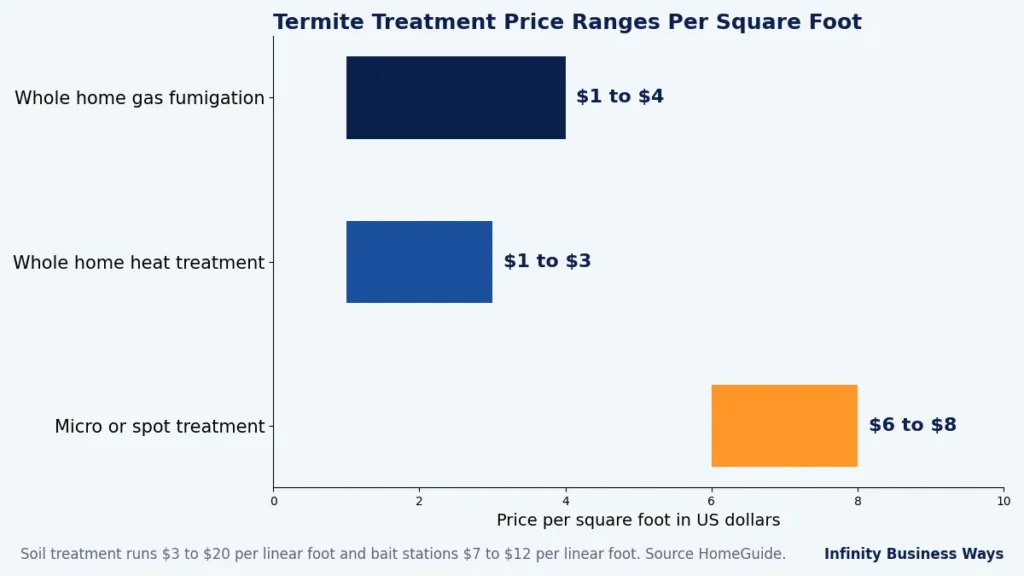
Fumigation is one method inside professional pest control, and it is the heaviest one. This table shows where it fits.
| Method | Best for | Typical price | Main limit |
| Whole home gas fumigation | Widespread or hidden drywood termites | $1 to $4 per sq ft | Days away from home and no lasting protection |
| Whole home heat treatment | Drywood termites when you prefer no pesticide | $1 to $3 per sq ft | Results can vary near large beams and other heat sinks |
| Micro or spot treatment | Small drywood spots you can locate | $6 to $8 per sq ft treated | Only works where the colony is actually found |
| Soil treatment or bait stations | Subterranean termites | $3 to $20 per linear ft for soil, $7 to $12 for bait | Does not reach termites living inside wood |
| Standard professional pest control | Ants, roaches, rodents and surface pests | Varies by plan | Cannot reach pests inside wood or wall voids |
Types of Fumigation Services
Residential Fumigation Services
This is the version most people picture. A licensed crew tents the whole house, releases sulfuryl fluoride and clears the home with a gas meter before anyone returns. Residential fumigation services are aimed mostly at drywood termites. The National Pest Management Association says drywood termites are commonly found on the West Coast, in Florida and in Hawaii, and can extend east to Texas and the Carolinas.
Commercial Fumigation Services
Warehouses, mills, food plants and distribution centers are treated whole building when stored product insects or rodents have taken hold. FSS describes nationwide structural fumigation with ProFume for food plants, bakeries, pet food makers, mills and pharmaceutical facilities. Ecolab offers warehouse fumigation for seeds, stored grain and dry goods. Commercial jobs are quoted by facility volume, downtime and audit paperwork, so expect custom pricing.
Shipping Container and Export Fumigation
Cargo and wood packaging often need treatment before they cross a border. The rules are specific enough that this guide covers them in their own section below.
Spot and Car Fumigation Services
Smaller tarps or chambers can treat furniture, a vehicle or one contained area instead of a whole building. It is far less common than tenting. A published field evaluation found that sulfuryl fluoride at a higher dosage eliminated resistant bed bugs from personal vehicles and from cargo trailers packed with household goods. Car fumigation services exist for that kind of case, but they are specialist work.
Termite Fumigation Services
Most home fumigation in the United States is about termites, so this is where the money is. Professional termite fumigation services target drywood species. If your inspector found subterranean termites, a soil treatment or bait system is the correct call, and a company that pushes tenting for them deserves a second opinion.
Fumigation kills the termites present at the time of treatment. It does not repair damaged wood and it does not protect the house afterward, which is why warranty terms matter. Budget for repairs separately from the treatment cost.
- Ask these four questions before you accept a termite quote.
- Which termite species did you confirm, and how?
- Will the fumigation be monitored with gas readings taken inside the structure?
- How long is the warranty, and what does it cover if termites return?
- Are repairs and retreatment priced separately in writing?
Bed Bug Fumigation Services
Bed bug fumigation services are the most oversold part of this industry. The University of Florida bed bug management manual says whole structure fumigation for bed bugs is very seldom practical or economically feasible, and points to heat and targeted integrated treatments first.
That does not mean gas fails. A bed bug dosage study found that sulfuryl fluoride killed every life stage, including eggs, at a rate about 1.7 times the drywood termite rate. It works, but it is rarely the first move. If a company recommends tenting your home for a few bugs in one room, get a second quote.
What Happens During a Fumigation Service Step by Step
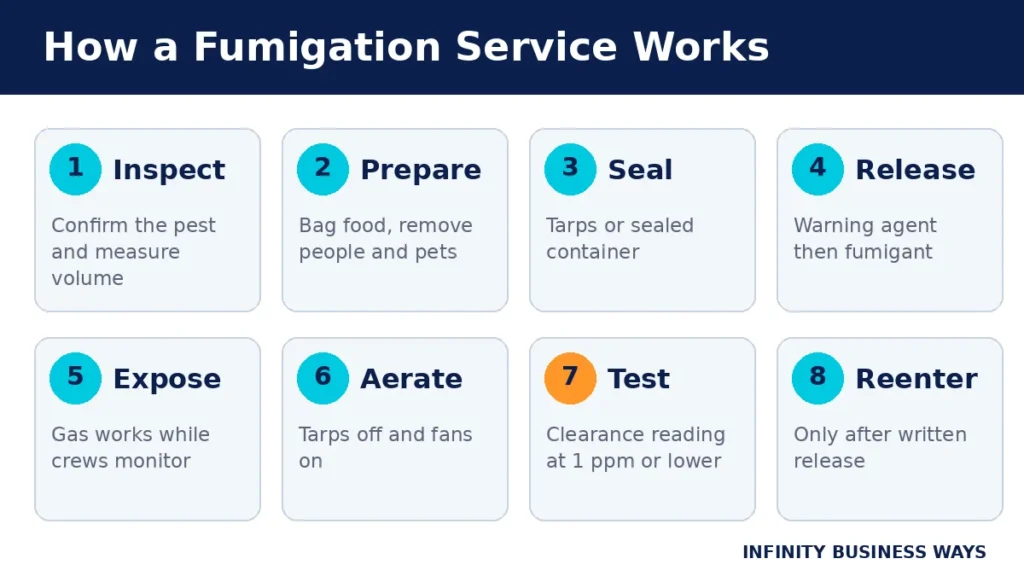
1. Inspection and quote. The technician confirms the pest, measures the structure and calculates volume.
2. Preparation. You remove or bag food, medication, pets and plants and follow the provider checklist.
3. Sealing. Tarps cover the building, or the container or warehouse is sealed, and warning signs go up.
4. Warning agent and gas release. Because sulfuryl fluoride is colorless and odorless, NPIC notes that chloropicrin, a strongly irritating substance, is commonly released first so anyone still inside leaves.
5. Exposure. The structure stays sealed while the gas works. Monitored jobs track concentration inside.
6. Aeration. Tarps come off and fans help the gas clear.
7. Clearance testing. The applicator measures the air with a clearance device and confirms sulfuryl fluoride is at 1 part per million or lower.
8. Reentry. You return only after the provider releases the structure. Some states also require advance notice. Florida, for example, requires licensees to notify its Department of Agriculture 24 hours before a structural fumigation through the FDACS fumigation notification system.
A Common Schedule
| Day | What usually happens |
| Day 1 | Final prep, tenting, warning agent and gas release |
| Day 2 | Exposure continues while crews monitor the structure |
| Day 3 | Aeration, clearance testing and written release if readings pass |
Your provider’s written schedule always wins over this example. Larger homes and cooler weather tend to stretch the timeline.
Fumigation Preparation Checklist
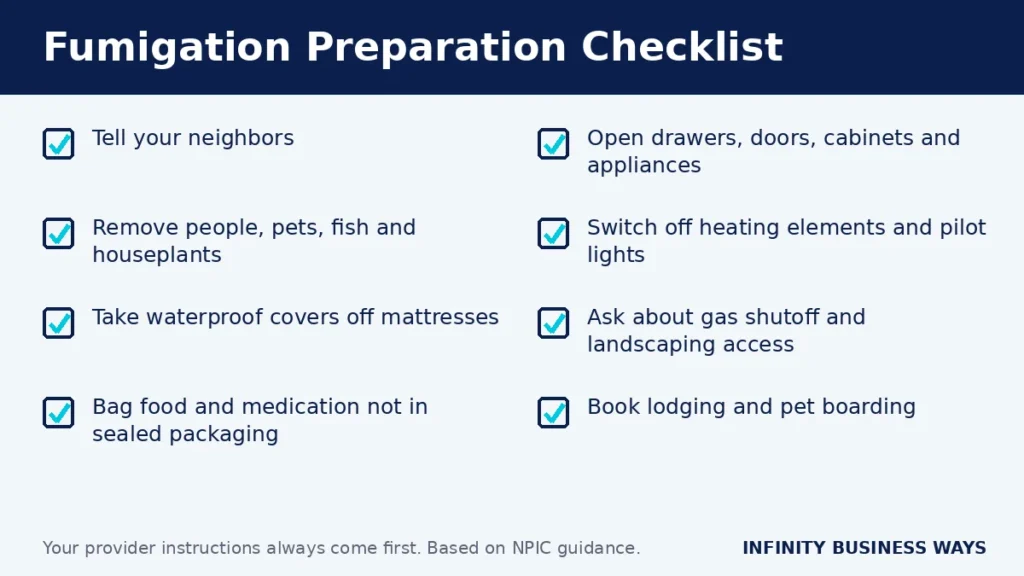
The NPIC preparation list is the best neutral starting point. Your provider’s own instructions override everything here.
- Tell your neighbors and ask them to keep children and pets away during treatment.
- Remove all people, pets, fish, reptiles and houseplants, since the gas can be toxic to all living things.
- Take waterproof covers off mattresses and pillows so gas does not pool.
- Remove or double bag food, feed, tobacco and medication that is not in sealed glass, metal or plastic packaging, including items in the refrigerator and freezer. Your provider usually supplies special bags.
- Open indoor drawers, doors, cabinets, closets, attic hatches and appliances such as the dishwasher and microwave.
- Unplug or switch off electrical heating elements and automatic controls, and put out pilot lights and open flames.
- Ask your provider about gas service shutoff, landscaping access and where to leave keys.
- Book lodging and pet boarding before the tent goes up, and confirm your return date in writing.
Fumigation Services Cost and How Long Fumigation Takes
HomeGuide puts tent fumigation at $1 to $4 per square foot, or $2,000 to $8,000 for an average sized home. Other published guides report lower typical figures for mid sized single story homes, so treat any range as a starting point and let written quotes settle it.
What Drives Your Quote
- Volume of the structure, including ceiling height and vaulted rooms
- Home size and the number of tents needed
- Roof type and access, such as tile roofs or tall trees against the house
- Pest and severity of the infestation
- Region, local labor rates, permits and notification fees
- Warranty length and what it covers
Costs Beyond the Quote
- Hotel or short term rental for several nights
- Pet boarding
- Replacing food and medication that cannot be sealed
- Repairs to wood already damaged, which are priced separately from treatment
Quick Math Helps
A 2,000 square foot home at $1 to $4 per square foot lands between $2,000 and $8,000 before lodging. Get two or three itemized written quotes so you can compare treatment, repairs and warranty line by line.
Are Fumigation Services Taxable
It depends on your state and on whether the property is residential or commercial. Florida does not tax residential pest control but does tax nonresidential services, according to the Florida Department of Revenue. Minnesota lists fumigating among taxable pest control services, as the Minnesota Department of Revenue explains. The Texas Comptroller says structural pest control services are taxable there. Check your own state revenue agency and ask for tax to be shown on the quote.
How Long Fumigation Takes
There is no single answer, because structure size, weather, dosage and clearance readings all change the schedule. The gas phase for a home commonly runs 24 to 72 hours, and most households should plan on roughly two to four days away.
What never changes is the exit rule. You go back in only after testing shows sulfuryl fluoride at 1 part per million or less, the level the EPA has determined is safe for reentry, as described in its EPA fumigation mitigation proposal. Container and commodity jobs are often shorter, but the destination rules set the schedule.
Is a Fumigation Service Safe
The system is built around safety. Sulfuryl fluoride is a restricted use pesticide, so only certified applicators can use it. Structures are sealed and posted with warning signs, the warning agent clears people out, and no one may reenter until a clearance device confirms 1 part per million or less. The EPA publishes its EPA clearance device testing so devices must prove they can read the clearance level accurately.
Safe does not mean risk free. A peer reviewed poisoning review in IJERPH notes that sulfuryl fluoride poisonings from structural fumigation still occur despite regulation, and that the common claim of no residue rests on limited studies. The practical lessons are simple.
- Never reenter before the provider releases the structure in writing.
- Never remove tarps, locks or warning signs yourself.
- Ask to see the final clearance reading and the device used.
- If you smell a sharp, irritating odor after release, stay out and call the company at once.
- If anyone feels unwell, move to fresh air and call Poison Control at 1 800 222 1222 in the United States, or emergency services if symptoms are severe. NPIC answers pesticide questions on weekdays at 1 800 858 7378.
When You Actually Need Fumigation
A trustworthy provider tells you early when you do not need it. Fumigation makes sense in these situations.
- Drywood termites in more than one area. When colonies sit inside beams, walls and attic wood you cannot reach, gas is the way to treat all of it at once.
- Signs you can see. Common clues include tiny pellets called frass, discarded wings near windowsills and wood that sounds hollow when tapped.
- Certain wood boring insects. The EPA lists wood boring insects among the structural pests that sulfuryl fluoride controls, in its EPA sulfuryl fluoride assessment.
- Stored product pests in food facilities. Mills, warehouses and plants use gas when infestations run deep in equipment and product.
- Cargo and wood packaging that must meet import rules. This is treatment for compliance, even when no pest is visible.
Fumigation is usually the wrong tool in these cases.
- Subterranean termites. The UC IPM subterranean termites state that fumigation, heat, freezing and electrocution devices cannot control them, because most of the colony stays near or below ground.
- Ants, roaches and rodents. Soil treatment, baits and targeted sprays cost less and skip the days of disruption.
- One small, located drywood spot. A micro treatment may be enough, though UC IPM warns that localized methods depend on finding the whole infestation.
Delay has a price. The NPMA estimates termites cause about $6.8 billion in property damage in the United States each year, and that cost is typically not covered by homeowners insurance.
Fumigation Services Near Me and How to Search Smarter
A search for fumigation services near me mixes national brands with local fumigation services. Either can do the job if the license is right. Read reviews that mention tenting or fumigation specifically, because a company with hundreds of ant and roach reviews may have done very few whole home jobs. Compare at least one local licensed operator with one national brand, and base the choice on the six point check above rather than on ad position.
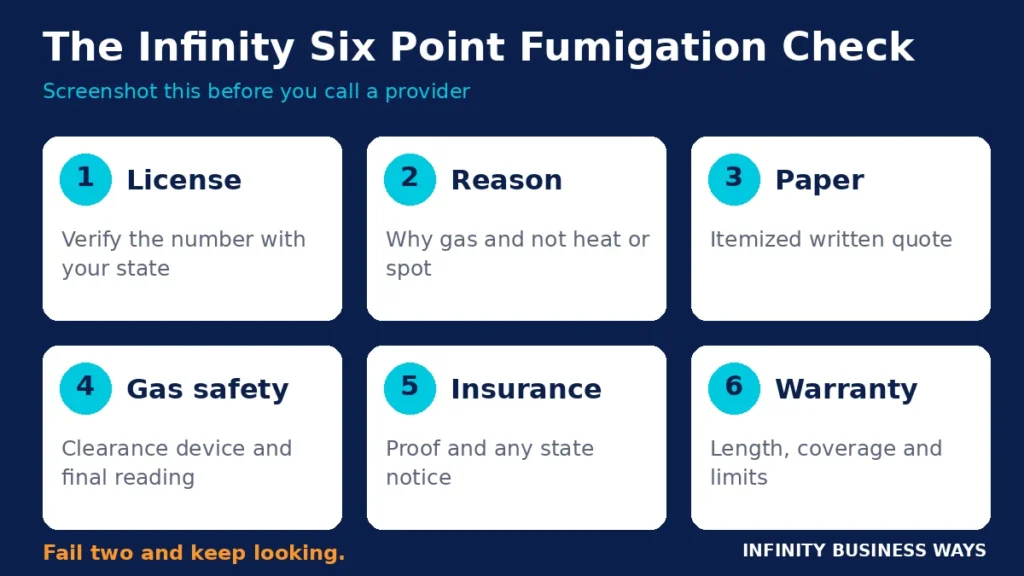
Six Infinity Points To Choose Fumigation Service
Screenshot this list before you call anyone. If a provider fails two of the six, keep looking.
- License. Ask for the license number and verify it with your state regulator. Many states license fumigation as its own category, so a general pest license may not be enough.
- Reason. Ask which pest they confirmed and why fumigation beats heat or a spot treatment for your case.q
- Paper. Get a written, itemized quote that separates treatment from repairs and includes the schedule, prep list and warranty.
- Gas safety. Ask who monitors the gas, which clearance device they use and whether you can see the final reading.
- Insurance and notice. Ask for proof of insurance and confirm they file any advance notice your state requires.
- Warranty. Get the length, what it covers and what voids it in writing before the tent goes up.
Fumigation Providers Worth Shortlisting by Need
This shortlist reflects what each company says it offers on its own site. It is not a ranking and not a paid placement. Licenses, coverage and quality vary by branch, so verify before you book.
For Home Termite Tenting
Terminix is one of the largest national brands, now part of Rentokil, and lists termite control services. Confirm that your local branch offers tent fumigation. Western Exterminator serves the Western United States and describes tenting and fumigation as its most effective option for drywood termites. Add at least one local licensed fumigator to your quote list.
For Warehouses, Food Plants and Commercial Buildings
Ecolab has offered fumigation across the United States for over 30 years, including warehouse, seed and stored grain work. FSS focuses on food, grain and pharmaceutical facilities with ProFume. Ehrlich lists commodity, container, silo and shipping fumigation.
For Shipping Containers and Export Cargo
FSS container services list container fumigation and approved treatment for Australia and New Zealand bound cargo. Atlantic Fumigation Services has worked out of Savannah, Georgia since 1981 and handles containers, warehouses and silos. For cargo arriving in Australia, Dock Fumigation in Melbourne advertises accreditation under the Australian Fumigation Accreditation Scheme.
Shipping Container Fumigation Services and Export Rules
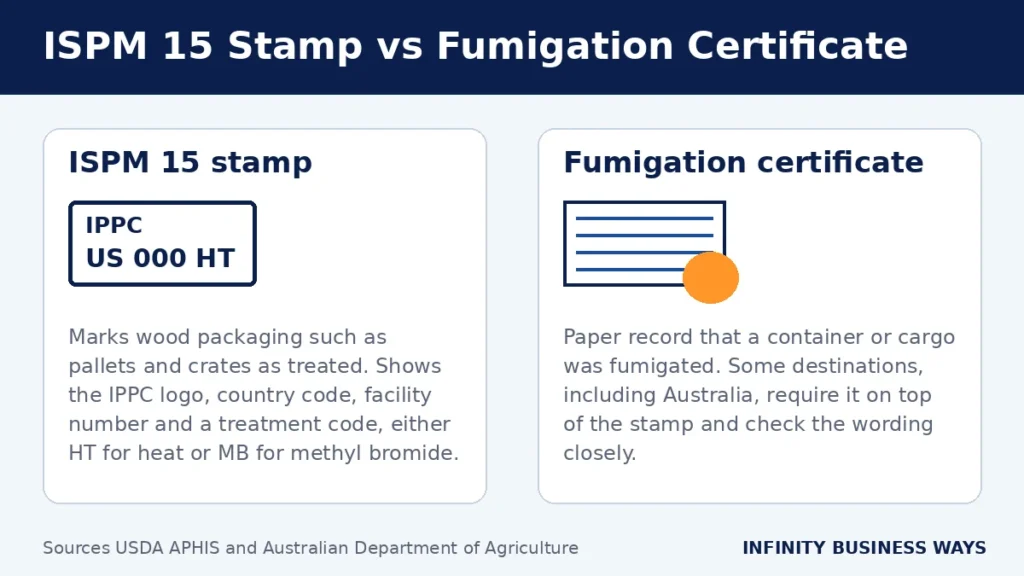
Countries protect their farms and forests by controlling what arrives in crates and pallets. The USDA says importers must make sure wood packaging is pest free, debarked, heat treated or fumigated and marked with an ISPM 15 logo, or the shipment cannot enter. The mark carries the IPPC logo, a two letter country code, a facility number and a treatment code, either HT for heat or MB for methyl bromide. The details are on the APHIS wood packaging rules.
One point trips up many shippers. The ISPM 15 stamp proves the wood packaging was treated. It is not the same thing as a fumigation certificate for a container or cargo, which some destinations require on top of the stamp.
Heat treatment means a wood core temperature of at least 56 degrees Celsius for at least 30 minutes, according to the APHIS wood packaging regulation. Methyl bromide is the other approved treatment, and many shippers now prefer heat because methyl bromide is being phased down for environmental reasons, as this ISPM 15 overview explains.
Australia adds its own layer. Its Fumigation Accreditation Scheme is a bilateral arrangement that manages the risk of ineffective methyl bromide treatments performed offshore, and the department updated its methyl bromide methodology to version 3.0 on 1 May 2025, with matching Australian fumigation certificate rules.
Export fumigation services are priced around load size and the destination certificate rather than square footage. Before you book, confirm the destination country requirements, ask the provider about experience with your commodity and ask for a sample certificate so you know the required statements will appear.
Also Read: Electrical Installations Explained With 2026 Costs and Codes
After Fumigation, Cleaning and Prevention
NPIC says residues are not expected on surfaces after a properly aerated structural fumigation. Some providers still offer a post fumigation cleaning service to wipe surfaces and settle dust. Ask your provider and follow the product label guidance for food, dishes and bedding.
Fumigation clears what is there but does not guard against what comes next. Schedule an inspection every year, seal gaps where winged termites could enter and keep firewood and scrap lumber away from the house.
Key Takeaways
- Fumigation services are for hidden pests, mainly drywood termites, and for cargo that must meet import rules.
- Expect about $1 to $4 per square foot for tenting, plus lodging and repairs.
- Subterranean termites, ants, roaches and rodents do not need whole structure gas.
- Safety rests on certified applicators, a warning agent, clearance testing at 1 part per million and written release.
- Use the Infinity Six Point Fumigation Check before you sign anything.
- For containers, an ISPM 15 stamp and a fumigation certificate are different documents.
FAQs About Fumigation Services
How long do fumigation services take?
There is no single timeline, because size, weather and clearance testing all matter. The gas phase for a home commonly runs 24 to 72 hours, and you should plan to be away roughly two to four days. Reentry is allowed only after testing confirms 1 part per million or less.
Can I fumigate my own home?
No. Sulfuryl fluoride is a restricted use pesticide, so only certified applicators can use it. The process also needs sealing, gas monitoring and clearance testing that untrained people cannot do safely. Ask a licensed provider about heat or spot treatment if cost is the concern.
Is fumigation the same as pest control?
No. Fumigation is one method inside pest control. Standard pest control sprays, baits or traps pests a technician can reach. Fumigation treats the whole enclosed space with gas and is reserved for pests hidden inside wood, walls or cargo, such as drywood termites.
Are fumigation services safe for pets and plants?
Not during treatment. The National Pesticide Information Center says sulfuryl fluoride can be toxic to all living things, so people, pets, fish, reptiles and houseplants must leave before the structure is sealed. They can return only after the provider confirms the air has cleared.
Where can I get shipping container fumigation services?
Look for licensed fumigators near your port or inland rail hub, and for Australia or New Zealand cargo confirm the required approvals. Providers such as FSS, Atlantic Fumigation Services and Ehrlich list container work. Check your destination rules first, then ask for the certificate wording they require.
Does fumigation work for bed bugs?
It can, but it is rarely the first choice. University of Florida guidance calls whole structure fumigation for bed bugs very seldom practical or economically feasible, even though research shows sulfuryl fluoride kills all life stages at higher dosage rates. Heat and integrated treatments usually come first.
Does insurance cover termite fumigation or damage?
Usually not. The National Pest Management Association says termite damage is typically not covered by homeowners insurance. Read your policy and any home warranty, and ask your provider what their own warranty covers after treatment.
Sources:
- EPA sulfuryl fluoride page
- EPA clearance device testing
- EPA fumigation mitigation proposal
- NPIC structural fumigation guide
- APHIS wood packaging rules
- Australian Fumigation Accreditation Scheme
- FDACS fumigation notification system
- UC IPM drywood termites
- UC IPM subterranean termites
- UF bed bug manual
- Bed bug dosage study
- Poisoning review in IJERPH
- NPMA drywood termite guide
- HomeGuide termite treatment costs
- Florida Department of Revenue
- Minnesota Department of Revenue
- Texas Comptroller