Residential Electrical Contractors and Services Complete Guide From 2026 Cost to Hiring Checklist
A residential electrical contractor is a licensed business that installs, repairs and upgrades the electrical systems in homes. The company employs licensed electricians, pulls the required permits, carries insurance and stands behind its work. Residential electrical services range from a single new outlet to a panel upgrade, rewiring or an EV charger circuit.
Quick answer
To hire the right residential electrical contractor, confirm the license, get proof of insurance from the insurer, ask for a written scope, make sure the permit and inspection are included and compare at least three itemized quotes. Expect about $50 to $130 per hour plus a $100 to $200 service call, and $150 to $600 for most small jobs.
Most people search for home electrical contractors when something has already gone wrong or a project is waiting. This guide explains who does what, what residential electrical services include, what they cost in 2026, how to check a license and insurance, and which red flags to avoid. It is written for US homeowners and uses named sources for every price and rule.
Table of Contents
What Is a Residential Electrical Contractor?
A residential electrical contractor is the company you hire for electrical work in a house, condo or apartment. In most states the company holds a contractor license, which lets it bid jobs, hire electricians and pull permits. A master electrician often has to qualify that license.
IBWays Tip
Hire an electrical contractor when the job needs a permit, a new circuit, a panel change or more than one electrician. Save the handyman for jobs that touch no wiring.
| Role | What they do | License | Hire for |
|---|---|---|---|
| Licensed electrician | Installs and repairs wiring under a contractor or master electrician | Individual license in many states | Work done through a contractor |
| Master electrician | Designs systems, supervises crews and often pulls permits | Highest individual license | Complex jobs and code questions |
| Electrical contractor | Business that bids jobs, employs electricians and pulls permits | Contractor license, usually with a master qualifier | New circuits, panels, rewiring |
| General contractor | Runs a whole remodel and brings in trades | General license where required | Large renovations |
| Handyman | Handles small repairs | Often limited for electrical work | Minor, like for like swaps where allowed |
What Residential Electrical Services Do Contractors Offer?
Residential electrical services are the installation, repair, upgrade and inspection work done on a home’s electrical system. They include wiring, circuits, outlets, lighting, panels, grounding and protection devices. Licensed electricians perform them, usually under a permit.
Repairs and troubleshooting
- Breakers that trip or will not reset
- Dead outlets, switches and light fixtures
- Flickering or dimming lights
- Burning smells, buzzing or warm outlets
New installations
- New circuits and outlets for kitchens, garages and additions
- Ceiling fans, recessed lighting and outdoor lighting
- Circuits for ovens, dryers, hot tubs and water heaters
Upgrades and safety
- Panel and service upgrades
- Partial or whole house rewiring
- GFCI and AFCI protection and whole home surge protection
- Replacement of outdated or aluminum wiring
Specialty work
- EV charger circuits
- Generator and transfer switch connections
- Smart switches and home automation wiring
- Electrical inspections before a purchase or after a renovation
How Much Do Residential Electrical Contractors Cost in 2026?
Most residential electricians charge about $50 to $130 per hour, plus a service call of $100 to $200 that covers the first hour. Small jobs usually total $150 to $600, and complex projects can reach $2,000 to $10,000 or more. These figures come from the multiple studies of ConsumerAffairs, the Angi and HomeGuide electrician hourly rates.
| Item | Typical 2026 range | Source basis |
|---|---|---|
| Hourly rate | $50 to $130, standard rates nearer $50 to $80 | ConsumerAffairs, Angi, HomeGuide |
| Service call, includes first hour | $100 to $200 | Angi, HomeGuide |
| Small job total | $150 to $600 | Angi, HomeGuide |
| Light fixtures, outlets, switches or fans | $141 to $419, average about $280 | HomeGuide |
| Average electrician job | About $351, range $163 to $538 | Angi |
| Complex projects | $2,000 to $10,000 | Angi |
| Emergency or after hours | About 1.5 to 2 times normal rates | ConsumerAffairs and market guides |
| Panel upgrade | $850 to $2,500 or $1,200 to $2,000 | HomeGuide, Angi |
| Whole house rewiring | About $7,000 to $20,000 or more | Angi and pricing guides |
What changes the price of residential electrical work?
- Location, since big cities often charge $100 or more an hour while rural areas run closer to $50
- License level, because master electricians charge the most
- Scope, access and the age of the wiring
- Materials, permit fees and inspection fees
- Emergency timing, such as nights and weekends
Flat rate or hourly pricing
Hourly billing fits troubleshooting, where nobody knows the scope yet. Many established shops price common jobs at a flat rate. Whatever the method, the quote should show labor, materials and the permit fee as separate lines so you can compare bids.
How to Choose a Residential Electrical Contractor– Checklist
The best residential electrical contractor is licensed, insured, willing to pull permits, clear about scope and price, and backed by recent reviews and references. We use a five step routine called the IBWays Pre Hire Checklist. Run it on every company before you sign.
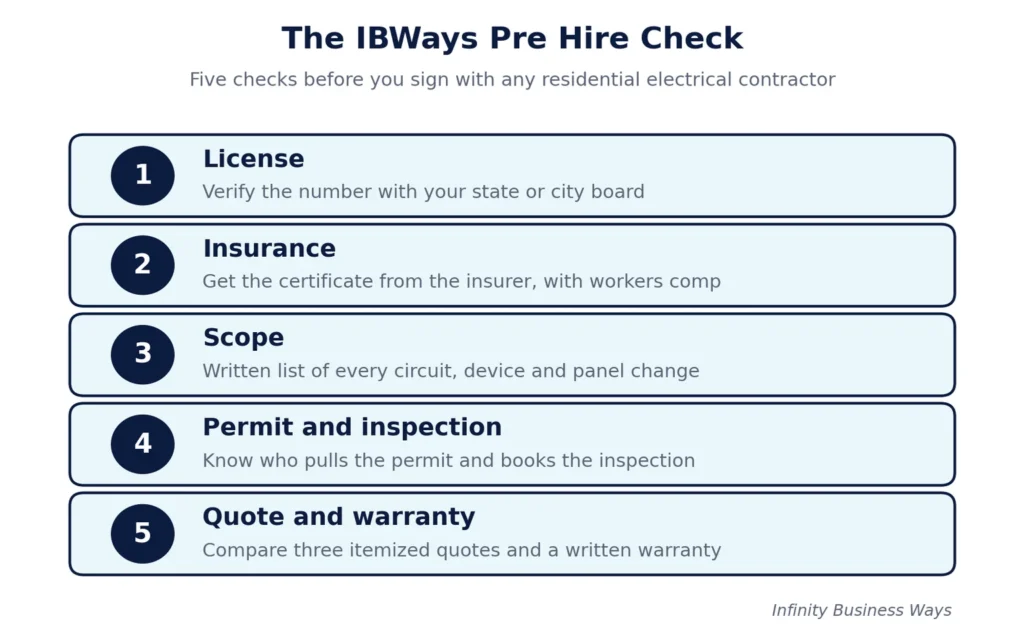
- License. Ask for the license number and verify it with your state or city board before you accept a quote.
- Insurance. Ask for a certificate of insurance sent by the insurer or agent. It should show general liability and workers compensation.
- Scope. Get a written scope that lists every circuit, device, panel change and material.
- Permit and inspection. Confirm who pulls the permit, who books the inspection and whether the fee is in the price.
- Quote and warranty. Compare at least three itemized quotes and ask for a written workmanship warranty with its length and coverage.
How Do You Check an Electrician’s License and Insurance?
Ask for the license number and company name, look them up with the licensing authority, then request a certificate of insurance from the insurer or agent. Do these checks before you sign, not after a problem.
- Collect the details. Get the exact business name, license number and the name of the master electrician on the license.
- Search the license. Use your state licensing board or city portal. In California, the California CSLB license check shows license status and complaints. Confirm the status is active, the name matches and the license type covers electrical installation work.
- Request the certificate. Ask the contractor to have the insurer or agent send a certificate of insurance that lists the coverage dates, limits and your project address.
- Confirm it is active. Call the insurer or agent to confirm the policy is in force. The PIA contractor insurance guide recommends this step.
- Check reputation. Read recent reviews on several platforms and ask for two references on jobs like yours.
Why workers compensation matters
General liability covers damage the contractor causes to your property and injuries to third parties. Workers compensation covers the contractor’s own employees. If a worker is hurt on your property and the contractor has no workers compensation, the claim may reach you, which is why a missing certificate is a stop sign.
Do Licensing Rules Vary by State?
Yes. Most states license electrical contractors at the state level, often through a qualifying master electrician, but a few leave licensing to cities and counties. One 50 state licensing guide names Illinois, Indiana, Kansas, Missouri, New York and Pennsylvania as states that rely on local rules, though guides disagree on exact counts, so check your own state and city.
Thresholds differ too. California requires a C10 contractor license for electrical work valued at $1,000 or more, according to the Next Insurance. Florida issues certified and registered electrical contractor licenses through its Department of Business and Professional Regulation. Insurance minimums also vary, from none statewide to set liability limits and bonds.
The BLS electrician outlook reports about 818,700 electrician jobs in 2024, a median wage of $62,350 and that most states require licenses. Titles vary by state, but the usual path runs from apprentice to licensed electrician to master.
Questions to Ask Before You Hire an Electrical Contractor
| Question | What a good answer sounds like |
|---|---|
| What is your license number and who is the master electrician? | A number you can verify and a named qualifier |
| Can you have your insurer send a certificate of insurance? | Yes, within a day, showing general liability and workers compensation |
| Will you pull the permit and book the inspection? | Yes, with the fee shown in the quote |
| Have you done this exact job in homes like mine? | Specific examples and two recent references |
| Who will do the work? | Employees or named subcontractors and their license level |
| Is the price flat or hourly, and what could change it? | A written scope and a change order process |
| Which materials will you use? | A list of devices, wire and breakers |
| What is the schedule and when will power be off? | Start and finish dates and expected outages |
| What warranty do you provide? | Written warranty with length and coverage |
| How do you handle hidden problems behind walls? | Written approval before any extra work |
What Should a Quote and Contract Include?
A good quote reads like a plan. It names the company and license, lists the work circuit by circuit, shows labor and materials separately and states the permit, schedule, payment terms and warranty.
- Company legal name, address and license number
- Circuit by circuit scope and a materials list
- Labor price and how it is billed
- Permit and inspection responsibility
- Start and finish dates
- Payment schedule tied to finished work
- Change order process in writing
- Cleanup, warranty and cancellation terms
How much deposit is normal?
Deposit rules vary by state. Virginia contractor hiring tips suggest no more than 10 percent or $1,000, whichever is less, with up to 30 percent when special order materials are needed. BBB scam warning signs tell homeowners to be wary of anyone asking for more than a third upfront. The DCP Consumer Protection stresses a written contract with a payment schedule that matches progress, and warns that a contractor who will not share insurance details is a red flag. Pay by check or card and avoid cash.
IBWays Quote Scorecard
With Checklist also copy this table and fill it in for each bid. The lowest price is not always the best, so look at the whole row.
| Item | Contractor A | Contractor B | Contractor C |
|---|---|---|---|
| License verified | |||
| Insurance certificate received | |||
| Permit and inspection included | |||
| Itemized materials | |||
| Total price | |||
| Payment schedule | |||
| Warranty length | |||
| Start date |
Red Flags When Hiring Home Electrical Contractors
- Asks for cash or a large payment before any written contract
- Will not share a license number or insurance details
- Says a permit is not needed for a new circuit or panel work
- Pushes you to decide today or knocks on your door offering a deal
- Quotes a price far below every other bid
- Offers a quote without listing the work
- Suggests a larger breaker as the fix for tripping
Why Permits and Inspections Matter?
A permit brings an inspector to verify the work meets code. Skipping it can cost you later. According to the NAR permit warning, unpermitted work can lead to a denied insurance claim, and most states ask sellers to disclose work done without a permit. A contractor who handles permits protects both of you.
Contractor, Handyman or DIY
Local rules differ, so ask your building department what homeowners may do on an owner occupied home.
| Task | Often fine where local rules allow | Hire a licensed electrician |
|---|---|---|
| Replace a bulb or cover plate | Yes | Not needed |
| Reset a tripped GFCI | Yes | If it will not reset |
| Swap a switch or outlet for the same type | Sometimes | If wiring looks damaged |
| Add an outlet or new circuit | No | Yes, with a permit |
| Panel or service change | No | Yes |
| EV charger circuit | No | Yes |
| Aluminum wiring repairs | No | Yes, with a specialist |
What Size Electrical Service Does a Home Need?
The National Electrical Code sets 100 amps as the minimum service for a new single family home, as noted by the CDA home wiring guide. Many older homes have 60 amp service, and the Mr. Electric says that size can raise questions when you renew a homeowner policy. Larger homes and homes with electric heat, air conditioning or EV charging often use 200 amps.
The panel label shows the rating. An electrician decides the right size with a load calculation that counts heating, cooling, appliances and EV charging. Signs you may need a bigger service include tripping breakers, no open slots and plans to add large loads.
| Servicesize | Typical home | Notes |
|---|---|---|
| 60 amp | Homes built before the 1960s | Limited capacity and may draw insurer questions |
| 100 amp | Smaller homes and the code minimum for new homes | Can feel tight with electric heat or EV charging |
| 150 amp | Midsize homes | A common upgrade step |
| 200 amp | Many newer and larger homes | Room for air conditioning, an electric range and an EV charger |
| 400 amp | Very large homes or heavy loads | Needs a load calculation |
What Counts as an Electrical Emergency?
If you see sparks, smell burning or find a hot panel or outlet, get everyone out if there is smoke or fire and call 911. If it is safe, switch off the main breaker, then call an emergency electrician. Emergency rates run about 1.5 to 2 times normal, roughly $100 to $260 an hour according to the ConsumerAffairs guide, so ask for the rate and arrival window up front and still verify the license.
What Happens During a Residential Electrical Project?
- Site visit and estimate. The contractor inspects the home and the panel.
- Written quote and contract. You compare bids and sign the scope.
- Permit. The contractor files the application.
- Work. Crews run wiring, set devices and make connections.
- Inspection. The inspector reviews and approves the work.
- Final walkthrough. You receive paperwork, test the circuits and get the warranty in writing.
Common Mistakes When Hiring a Residential Electrician
- Choosing the lowest bid without comparing scope
- Skipping license and insurance checks
- Paying a large deposit before work starts
- Letting work start with only a verbal agreement
- Not asking who pulls the permit
- Ignoring warning signs such as tripping breakers
Final Thoughts on Hiring a Residential Electrical Contractor
The right contractor is licensed, insured, clear about the permit and honest about price. Run the IBWays Pre Hire Check, fill in the Quote Scorecard for at least three bids and keep every document. A little checking before you sign is far cheaper than fixing unpermitted or unsafe work later.
Residential Electrical Contractor FAQs
What does a residential electrical contractor do?
A residential electrical contractor installs, repairs and upgrades the wiring and electrical equipment in homes. Typical work includes new circuits, outlets, lighting, panel upgrades, rewiring, EV charger circuits and fixing breakers that trip. The company usually pulls permits, schedules inspections and carries insurance, while licensed electricians perform the work.
How much do residential electrical contractors charge?
Most charge about $50 to $130 per hour, plus a service call of $100 to $200 that covers the first hour. Small jobs usually total $150 to $600, while complex projects can reach $2,000 to $10,000 or more. Rates rise in big cities and for emergency or after hours calls.
Is an electrician the same as an electrical contractor?
Not quite. An electrician is an individual with a license to do electrical work. An electrical contractor is a business license that lets a company bid jobs, hire electricians and usually pull permits, often with a master electrician qualifying the license. Many electricians work for contractors, and some own contracting businesses.
How do I verify an electrician’s license?
Ask for the license number and business name, then search your state licensing board or city portal. Confirm the status is active, the name matches and there are no serious complaints. California offers a CSLB license check. If your state licenses locally, call the city or county building department.
Do residential electrical contractors pull permits?
Usually yes. A contractor license generally allows the company to pull permits, and the inspector then reviews the finished work. Ask who pulls the permit and whether the fee is in your quote. Be cautious if a contractor says a permit is not needed for a new circuit or panel work.
Can a handyman or general contractor do electrical work?
Rules vary by state and city. Many places limit handymen to minor like for like swaps, and general contractors usually hire a licensed electrical contractor for wiring. If the job adds a circuit, changes a panel or needs a permit, hire a licensed electrician and confirm the license before work starts.
What size electrical service does a home need?
The National Electrical Code sets 100 amps as the minimum service for a single family home. Many older homes have 60 amps, and many new or larger homes get 200 amps. The right size depends on a load calculation that counts heating, cooling, appliances and EV charging.
How much deposit should I pay an electrician?
Deposit rules vary by state. Virginia guidance suggests no more than 10 percent or $1,000, whichever is less, and up to 30 percent for special order materials. The Better Business Bureau warns against paying more than a third upfront. Tie further payments to finished work and pay by check or card.
What insurance should an electrical contractor have?
At minimum, ask for general liability insurance, which covers property damage and injuries to third parties, and workers compensation, which covers the contractor’s employees. Request a certificate of insurance from the insurer or agent, confirm the policy is active and check the coverage dates. Requirements vary by state.
How do I find a good residential electrician near me?
Search your state license board and local directories, then ask neighbors and your local building department for names. Shortlist three licensed, insured companies, check recent reviews on several platforms and ask for references on similar jobs. Compare itemized written quotes instead of choosing the lowest price or the first call back.
Sources and references
- ConsumerAffairs electrician cost guide for hourly rates and emergency pricing
- Angi electrician cost guide for job averages and ranges
- HomeGuide electrician hourly rates for service call fees
- HomeGuide electrical pricing for small job and panel pricing
- 50 state licensing guide for state licensing structure
- Next Insurance licensing guide for California licensing
- PIA contractor insurance guide for insurance checks
- Connecticut home improvement guidance for contract and guaranty fund details
- Virginia contractor hiring tips for deposit guidance
- BBB scam warning signs for deposit and scam warnings
- NAR permit warning for permit and disclosure risks
- CDA home wiring guide for service size minimums
- Mr. Electric amp guide for older service sizes
- BLS electrician outlook for workforce and licensing context
This guide is researched information to be acknowledged before scam and overpaying but does not replace advice from a licensed electrician or your local building department. Prices, licensing and permit rules vary by location.