
Electrical Installations Explained With 2026 Costs and Codes
An electrical installation is the complete set of wiring, panels, circuit breakers, outlets, switches, lights and connected equipment that carries power from the utility service to the devices that use it. It includes new wiring, upgrades and repairs, and it must follow the National Electrical Code and local permit rules.
Quick answer:
A safe electrical installation follows seven steps. Plan the load, pull the permit, run the wiring, install the panel and grounding, test the circuits, pass inspection and connect power. Small jobs such as outlets and fixtures often cost about $140 to $420, panel upgrades and rewiring cost much more, and licensed electricians should handle anything beyond a simple like for like swap.
This guide is written for US homeowners, landlords and small business owners. Costs are shown as ranges from named sources, code references follow the National Electrical Code, and each section ends with what to ask your electrician.
Table of Contents
What Is an Electrical Installation?
In plain terms, an electrical installation is everything permanently wired into a building. That covers the service entrance where utility power arrives, the meter, the main panel, branch circuits, outlets, switches, lighting, grounding and any hardwired equipment such as an electric water heater or EV charger. A lamp plugged into the wall is not an installation, but the outlet behind it is.
What an electrical installation includes
- Service entrance and electric meter
- Main panel, main breaker and branch breakers
- Cables, conduit and junction boxes
- Outlets, switches and light fixtures
- Grounding and bonding
- Hardwired appliances and equipment
- Protection devices such as GFCI, AFCI and surge protectors
What Are the Types of Electrical Installations?
Electrical installations fall into three main types. Residential installations serve homes and apartments, commercial installations serve offices, shops and other businesses, and industrial installations serve factories and heavy equipment sites. Capacity, wiring methods and inspection needs increase as you move from residential to industrial. Specialty installations such as solar systems, generators and data wiring sit alongside these three types and often need their own permit.
| Type | Typical places | Power and wiring | Common work |
|---|---|---|---|
| Residential | Houses and apartments | Single phase 120 and 240 volt service with cable or conduit | New circuits, rewiring, panel upgrades, EV chargers, lighting |
| Commercial | Offices, retail, restaurants, clinics | Often three phase service, conduit and larger panels | Tenant fit outs, lighting controls, equipment circuits, emergency lighting |
| Industrial | Factories, warehouses, plants | Three phase power, heavy feeders and motor controls | Machine hookups, motor circuits, power distribution |
Electrical Installation Services Homeowners and Landlords Hire For
Electrical installation services cover any work that adds, changes or replaces fixed wiring and equipment. Residential electrical service providers usually group the work like this. Hire for scope, not price alone. A good quote names the circuits, devices, permit and inspection responsibilities so you can compare bids line by line.
- New circuits for kitchens, garages, workshops and additions
- Whole house or partial rewiring in older homes
- Electrical panel and sub panel installation or replacement
- Service upgrades from 100 amp to 200 amp
- Lighting, ceiling fans and outdoor lighting
- GFCI, AFCI and whole home surge protection
- EV charger circuits
- Hardwired appliances such as water heaters, electric furnaces and hot tubs
- Generator and transfer switch connections
- Corrections after a failed or flagged inspection
GFCI, AFCI and Surge Protection Requirements
GFCI protection stops shock by cutting power when current leaks to ground. AFCI protection detects dangerous arcing in wiring and cords. Surge protection limits voltage spikes at the service. The 2023 NEC expanded GFCI and AFCI coverage, and the 2020 NEC first required surge protection at dwelling services, as covered in IAEI 2023 NEC changes.
Where GFCI protection is required in homes
- Bathrooms and kitchens, including all kitchen receptacles under the 2023 NEC
- Garages, accessory buildings and outdoor outlets
- Basements and crawl spaces
- Laundry areas and indoor damp or wet locations
- Receptacles within six feet of a sink
- Dishwasher outlets and other listed appliances
Where AFCI protection is required in homes
AFCI protection covers most 15 and 20 amp, 120 volt circuits serving living areas, including bedrooms, living rooms, dining rooms, family rooms, hallways, closets, laundry areas and kitchens.
See the EC&M GFCI AFCI guide for the full lists. States and cities change these lists. Idaho, for example, narrows AFCI in one and two family homes to bedroom circuits, so confirm local rules before you buy materials.
How Does an Electrical Installation Work Step by Step?
Most projects follow the same seven steps, whether the job is one new circuit or a full rewiring. Skipping the permit or inspection is a common reason finished work has to be opened up later, and it can create insurance and resale problems.
- Plan and calculate the load. The electrician totals the power the new circuits and equipment will draw so the panel and service are not overloaded.
- Pull the permit. Most new circuits, panel work and service changes need a permit approved by the local authority.
- Rough in the wiring. Cable or conduit is run through walls, ceilings and floors and boxes are set before walls are closed.
- Pass the rough in inspection. Where required, the inspector checks wire size, box placement and cable support before insulation and drywall go up.
- Install the panel, devices and grounding. Breakers, outlets, switches and fixtures are connected, and the grounding system is bonded to the panel.
- Test the circuits. The electrician checks continuity, voltage, polarity and the function of GFCI and AFCI devices.
- Pass the final inspection and connect power. After approval, the system is energized and ready for use.
Electrical installation wiring diagram
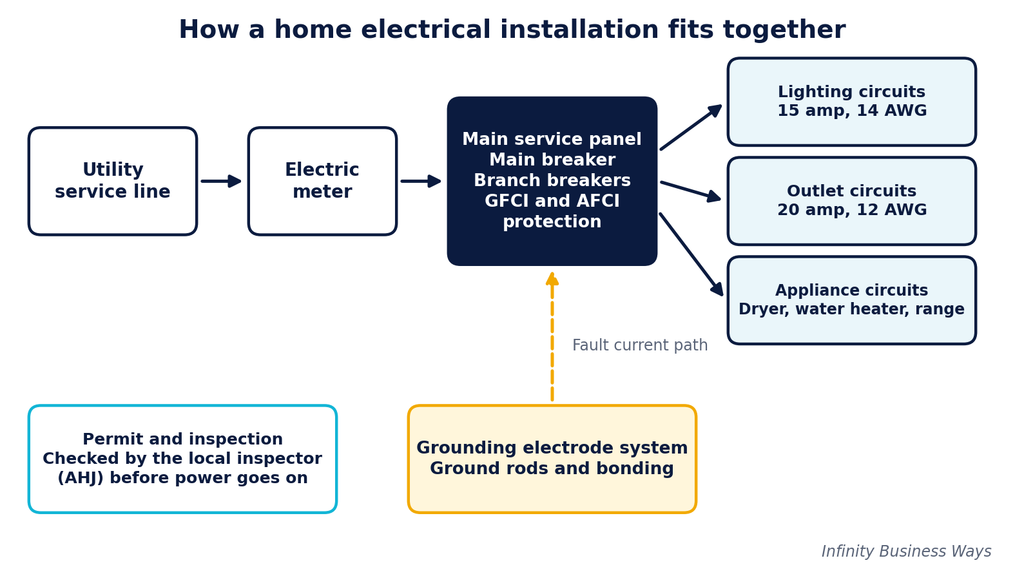
The diagram shows the path power takes. Utility power reaches the meter and then the main service panel. The main breaker can cut power to the whole house, and branch breakers protect each circuit. A grounding electrode system connects the panel to the earth so fault current has a safe route.
Electrical Panel and Sub Panel Installation
An electrical panel, also called a breaker box, divides incoming power into protected circuits. A sub panel is a smaller panel fed from the main panel that adds circuits near a garage, workshop, addition or outbuilding.
When do you need a panel upgrade?
- Breakers trip often or there are no open breaker slots
- You are adding an EV charger, heat pump, hot tub or electric range
- Your service is smaller than your planned load, since many older homes have 60 or 100 amp service while many new loads call for 200 amp
- The panel is damaged, crowded or flagged by an inspector or insurer
Capacity decides what you can add. A 100 amp service that already carries an electric range, dryer, water heater and air conditioning may not have room for a large EV circuit, which is why an electrician runs a load calculation before quoting.
Panel upgrade prices vary. Angi panel cost data points to roughly $1,200 to $2,000 for typical work, while HomeGuide electrical pricing reports $850 to $2,500. Larger service changes cost more.
What Wire Size Matches Which Breaker?
NEC section 240.4(D) limits the breaker size allowed on small copper wire, so wire gauge and breaker size must be matched. A breaker that is too large for the wire can let the cable overheat before the breaker trips.
| Copper wire | Maximum breaker | Common use |
|---|---|---|
| 14 AWG | 15 amp | Lighting and light duty circuits |
| 12 AWG | 20 amp | General outlets, kitchens, bathrooms and garages |
| 10 AWG | 30 amp | Dryers and many electric water heaters |
Aluminum wire has lower limits. Twelve gauge aluminum is capped at 15 amp and ten gauge aluminum at 25 amp. Heavier loads such as ranges, EV chargers and sub panels use larger conductors sized from NEC tables, so leave those calculations to a licensed electrician.
What do wire colors mean?
In US home wiring, black and red wires are usually hot conductors, white is neutral, and green or bare copper is ground. Colors can be reused in older homes and in switch loops, so always test with a meter before touching any wire.
Grounding, Bonding and Ground Rods
Grounding connects the electrical system to the earth, and bonding ties metal parts together so a fault creates a safe path that trips the breaker. In the US this is called grounding, while the same idea is called earthing in the UK and many other countries.
A ground rod is a metal rod driven into the soil as part of the grounding electrode system. Rods are commonly eight feet long, and installers often use two rods unless testing shows low enough resistance, because soil conditions vary. Many services also connect to a metal water pipe or a concrete encased electrode where one exists. Your local inspector decides which electrodes are required.
NEC Codes, Permits and Inspections Before Connection
What is the National Electrical Code?
The National Electrical Code, also called NFPA 70, is a standard for safe electrical installation. The NFPA publishes a new edition every three years, but it is not federal law. States, counties and cities decide which edition to enforce and what local changes to add. Check the NFPA NEC enforcement map for your state.
Which NEC edition applies to my project?
The 2026 edition has been released, but adoption is uneven. The IAEI adoption list shows states on the 2023 and 2020 editions and a few moving to 2026, while some trackers report that no state had fully enforced the 2026 edition by mid 2026. The enforceable edition depends on your state, local amendments and the date your permit is issued, so ask your local building department.
Do I need a permit for electrical work?
Most new circuits, panel changes, service upgrades and EV charger circuits need a permit. Simple like for like swaps, such as replacing a switch or outlet with the same type, are often exempt, but rules differ by city and county.
What does an electrical inspector check?
- Wire sizes and breaker ratings
- Grounding and bonding
- GFCI and AFCI protection where required
- Box fill, cable support and protection
- Outlet spacing and placement
- Whether the work matches the approved permit
The inspector, often called the Authority Having Jurisdiction or AHJ, approves the work before power is connected. A passed inspection also gives you a record that can help with insurance questions and resale.
How Much Does Electrical Installation Cost in 2026?
Most small electrical jobs such as outlets, switches and fixtures cost between $140 and $420, panel upgrades commonly run $850 to $4,000, and whole house rewiring often runs from several thousand dollars to $20,000 or more. Prices vary by region, home age and how easy the wiring is to reach.
| Job | Typical range | Source basis |
|---|---|---|
| Light fixtures, outlets, switches or fans | $141 to $419, average about $280 | HomeGuide |
| Outlet install or replacement | $120 to $350 | HomeGuide and market guides |
| Electrician hourly rate | $50 to $150 | Market pricing guides |
| Service call or minimum fee | $75 to $200 | Market pricing guides |
| Panel upgrade | $850 to $2,500, up to $4,000 for larger work | HomeGuide, Angi, market guides |
| Whole house rewiring | About $7,000 on average, often $8,000 to $20,000 or more | Angi data, market guides |
| EV charger installation | $600 to $2,500 | Market pricing guides |
Sources differ because they sample different markets and project sizes, so treat these figures as ranges and collect at least three written quotes.
What changes the price of electrical installation?
- Scope and the number of new circuits
- Access, such as finished walls, crawl spaces and attics
- Home age and the condition of existing wiring
- Permit and inspection fees
- Local labor rates and copper prices
- Panel capacity and whether a service upgrade is needed
How to read an electrical estimate
A properly scoped estimate lists the core materials, not only labor hours. Look for wire and cable, breakers, GFCI and AFCI devices, boxes, grounding hardware and the permit fee. Ask whether inspection is included, whether the price is flat or hourly, and what happens if hidden problems appear after walls are opened.
Commercial Electrical Installation Basics
Commercial electrical installation is the design and wiring of power, lighting and equipment circuits in non residential buildings. These projects usually need permit drawings, a licensed contractor and a plan review, and they often use conduit, three phase panels and dedicated circuits for equipment.
What changes compared with a home
- Higher electrical load and often three phase service
- Metal conduit or raceway wiring in many building types
- Dedicated circuits for kitchens, HVAC, server rooms and signage
- Emergency and exit lighting, plus fire alarm coordination
- Plan review, phased inspections and sometimes a utility inspection
Tenants should confirm who pulls the permit, who owns the panel and who pays for service upgrades before signing a lease or hiring a contractor.
EV Charger Installation Basics
A Level 2 EV charger runs on a dedicated 240 volt circuit. Charging is a continuous load, so the circuit is sized at 125 percent of the charger’s maximum draw.
| Charger draw | Minimum breaker | Typical use |
|---|---|---|
| 32 amp | 40 amp | Common plug in or hardwired units |
| 40 amp | 50 amp | Mid power home chargers |
| 48 amp | 60 amp | Faster hardwired units |
A plug in charger on a 50 amp outlet is typically limited to 40 amps continuous. Your panel decides whether the circuit fits, because a 100 amp service with an electric range, dryer, water heater and air conditioning may not have room for a 60 amp EV circuit. Many cities expect a permit for a new charger circuit. Installation commonly runs $600 to $2,500 depending on the distance from the panel and the spare capacity available.
Other Common Electrical Installations at a Glance
| Project | What the circuit usually needs | Who should do it |
|---|---|---|
| Electric water heater | Dedicated 240 volt circuit sized to the nameplate, often 30 amp on 10 AWG for common tank models, plus a nearby disconnect where required | Licensed electrician |
| Electric furnace | Dedicated 240 volt circuit sized from the nameplate | Licensed electrician |
| Hot tub | Dedicated 240 volt circuit with GFCI protection and a disconnect, commonly 50 or 60 amp | Licensed electrician |
| New outlet | Extension of an existing circuit if capacity allows, correct box and GFCI where required | Licensed electrician in most areas |
| Electric fireplace Installation | Many units plug into a standard 120 volt outlet, larger inserts may need a dedicated circuit | Check the manual |
| Electric fence charger | Standard outlet or solar power, with a properly installed ground rod | Follow the maker’s instructions |
Signs You Need Electrical Work
- Breakers trip repeatedly
- Lights flicker or dim when appliances start
- Outlets or switch plates feel warm
- A burning smell or buzzing from outlets or the panel
- Two prong outlets with no ground
- Old fuse boxes or panels an inspector has flagged
- Extension cords used because there are too few outlets
- Aluminum branch wiring, which was used in some homes built roughly between 1965 and 1973
The CPSC reported that homes with older aluminum branch wiring made before 1972 are 55 times more likely to have connections that reach fire hazard conditions than homes wired with copper. That does not mean a fire is likely. It means connections need a specialist inspection and approved repair methods.
Read the InterNACHI aluminum wiring guide and tell your insurer before repairs, since some insurers charge more or decline coverage for untreated aluminum wiring.
Can I Do Electrical Installation Myself?
Homeowner work is allowed in many areas, usually with a permit, but rules differ by state and city and some places restrict panel and service work. Always switch off the breaker and confirm power is off with a tester before touching any wire.
| Often reasonable for a careful homeowner | Hire a licensed electrician |
|---|---|
| Replacing a damaged cover plateSwapping a switch or outlet for the same type where local rules allowReplacing light bulbs and plug in smoke alarmsResetting a tripped GFCI | New circuits and added outletsPanel, sub panel and service workEV chargers, hot tubs and water heater circuitsAluminum wiring repairsAny work inside a live panel |
Electrical Fire Safety
If you see sparks or smell burning, get everyone out first and call emergency services. Cut power at the main breaker only if it is safe to reach. Never use water on an electrical fire. A Class C or ABC extinguisher is suited to electrical fires and should be aimed at the base of the flames.
NFPA data for 2015 to 2019 shows that electrical failure or malfunction caused about 13 percent of US home structure fires and 21 percent of property damage, with roughly 390 deaths and 1,300 injuries a year, and about two thirds of those fires involved arcing. The USFA reports lower figures, about 23,400 fires and 200 deaths a year for 2011 to 2020, because the datasets use different methods.
How to lower electrical fire risk
- Avoid overloaded outlets and long extension cord chains
- Replace damaged cords and loose or discolored outlets
- Test GFCI and AFCI devices monthly, following the maker’s instructions
- Keep smoke alarms working
- Do not ignore warm outlets or breakers that trip repeatedly
Common Electrical Installation Mistakes
- Doing major wiring without a permit
- Undersizing a circuit for a water heater or EV charger
- Putting a larger breaker on wire that cannot carry it
- Ignoring grounding and bonding
- Hiring on price alone without an itemized quote
- Assuming all electrical work is equally simple
Electrical Maintenance Checklist
| Task | How often | Who |
|---|---|---|
| Press test and reset on GFCI outlets | Monthly | You |
| Use the test button on AFCI breakers | Monthly | You |
| Test smoke alarms | Monthly | You |
| Check cords, plugs and outlets for heat or damage | Each season | You |
| Inspect the panel, grounding and surge protection | Every few years, and when buying or renovating | Licensed electrician |
How to Hire a Licensed Electrician Near You
Searching for an electrician near me gives you a long list, but the right choice comes down to five checks. We call this the IBWays Pre Hire Check, and you can use it for any residential electrical service or commercial job.
- License. Confirm the license number with your state or local board before you get a quote.
- Insurance. Ask for proof of liability insurance and workers compensation.
- Scope. Get a written scope that lists every circuit, device and panel change.
- Permit and inspection. Confirm who pulls the permit and who schedules the inspection.
- Quote and warranty. Compare at least three itemized quotes and ask for a written workmanship warranty.
The BLS electrician outlook reports about 818,700 electrician jobs in 2024, a median wage of $62,350 and a note that most states require licenses. Most electricians train through apprenticeships with about 2,000 paid hours a year. Titles vary by state, but the usual path runs from apprentice to licensed electrician to master, and masters often pull permits and supervise others.
Questions to ask before you hire
- Have you completed this exact type of job before
- Will you pull the permit and handle inspection
- How do you price hidden problems found behind walls
- Who will be on site and what is their license level
- Can you share a recent reference for similar work
Also Read: Termite Fumigation Services 2026 Cost and Safety Guide
Final Thoughts on Electrical Installation
A safe electrical installation comes down to correct planning, a permit, properly sized wire and breakers, working protection devices and a passed inspection. Run the IBWays Pre Hire Check before you sign, keep your quote and inspection records, and use the cost ranges above to judge whether a price is fair.
Electrical Installation FAQs
What are the three types of electrical installation?
Residential covers homes, commercial covers offices and shops with larger loads, and industrial covers factories with three phase motors and heavy distribution. Specialty installations such as solar, generators and data wiring form a fourth group that often needs separate permits.
How long does an electrical installation take?
A single outlet or fixture often takes one to two hours. A panel upgrade commonly takes about a day, and a whole house rewire can take several days to a few weeks depending on size and access. Permit and inspection scheduling can add more time.
How much does it cost to install an electrical outlet?
Most outlet installs cost $120 to $350 depending on whether an existing circuit can be extended, how easy the wall is to open and whether GFCI protection is needed. A new dedicated circuit costs more than an added outlet.
Can I install a new electrical outlet myself?
Replacing an outlet with the same type is often allowed for homeowners. Adding a new outlet means extending a circuit, checking capacity and meeting GFCI or AFCI needs. Many areas require a permit, so check locally or hire a licensed electrician.
What is the difference between a panel and a sub panel?
The main panel receives power from the utility service and holds the main breaker. A sub panel is fed from a breaker in the main panel and powers a separate area such as a garage or addition. It needs correct feeder wire, grounding and neutral separation.
What happens if an installation fails inspection?
The inspector lists the problems, you correct them and request a reinspection. Power connection is usually held back or the permit stays open until the work passes. Fixing issues early is cheaper than opening finished walls later.
How much does it cost to install an EV charger at home?
Installs commonly run $600 to $2,500, with the charger itself extra. Price depends on distance from the panel, spare panel capacity, conduit or trenching needs and permit fees.
Why do breakers keep tripping?
A breaker trips when a circuit is overloaded, shorted or has a ground fault. Repeated tripping points to too many devices on one circuit, a failing appliance or damaged wiring. Do not swap in a larger breaker. Have an electrician find the cause.
What does earthing mean in electrical installation?
Earthing is the UK and international word for grounding. It connects the electrical system to the earth through electrodes such as ground rods so fault current has a safe path and protective devices can trip quickly.
Sources and references
- BLS electrician outlook for jobs, pay and licensing context
- IAEI adoption list for NEC edition by state
- NFPA NEC enforcement map for state level enforcement
- IAEI 2023 NEC changes for GFCI, AFCI and surge updates
- EC&M GFCI AFCI guide for protection locations
- USFA electrical fire trends for fire statistics
- Angi panel cost data for panel pricing
- HomeGuide electrical pricing for job pricing
- InterNACHI aluminum wiring guide for aluminum wiring risks



One Comment