What Is Chipboard Meaning Types Thickness and Projects
Chipboard is a flat, rigid board with two common meanings. In the United States it usually means thick paperboard pressed from recycled paper fibers, used for notepad backs, packaging, book covers and crafts. In Britain and in the building trade it means particleboard, an engineered wood panel made from wood chips and resin.
Many people search for chip board, chipboards or a chipboard and land on the wrong product. This guide fixes that. You will learn what chipboard is made of, how thick each grade is in points, millimeters and inches, what it is used for, how it compares with cardboard and MDF, and where to buy the right kind for your job.
Key Takeaways
- Paper chipboard is recycled paper fiber pressed into one solid sheet with no hollow middle.
- Wood chipboard is particleboard made from wood chips and resin.
- Paper chipboard thickness is measured in points, and one point equals 0.001 inch.
- Plain chipboard is not archival and is not a safe first choice for direct food contact.
- Always check the material, the thickness and the finish before you buy.
Table of Contents
What Is Chipboard? And how is it made
Chipboard is a general name for dense, flat board built from compressed fiber or particles. The meaning changes by country and by trade. Britannica describes it as a cheap paperboard used as photograph backing and in cartons, and says that in Britain the word refers to pressed wood clippings used in furniture.
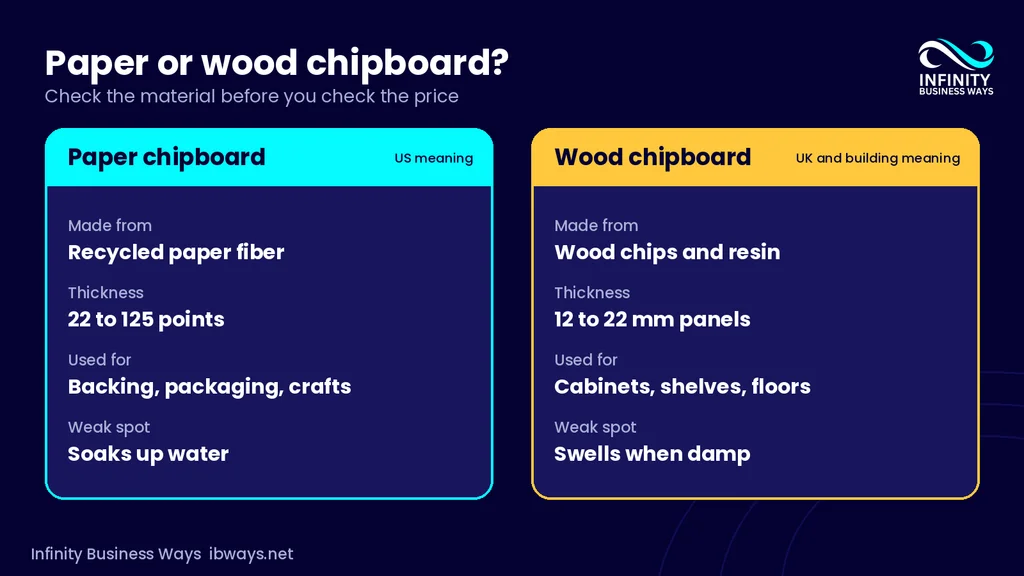
| Feature | Paper chipboard (US) | Wood chipboard (UK and building) |
|---|---|---|
| Also called | Greyboard, recycled paperboard | Particleboard, particle board |
| Made from | Recovered paper fiber pressed in layers | Wood chips, shavings and resin pressed with heat |
| Common thickness | About 0.022 to 0.125 inch for typical sheets | 12 mm to 22 mm and 3/4 inch panels |
| Common size | 8.5 x 11 in up to 28 x 44 in sheets | 4 ft x 8 ft panels |
| Cut with | Craft knife, trimmer or die cutter | Saw or panel saw |
| Main uses | Notepad backs, packaging, book covers, crafts | Furniture, cabinets, shelving, floor decking |
| Moisture | Absorbs water unless coated | Swells when it gets damp |
Check the material before you check the price.
How to Tell Which Chipboard a Seller Means
Look at the other words in the listing. alike pallet sheet, pad, scrapbook, mounting, backing and binding point to paper chipboard. Words like melamine, shelf, cabinet, subfloor and panel point to wood chipboard.
A third case shows up in craft shops. Some listings label quarter inch MDF sheets as chipboard, so read the material line before you pay.
What Are Chipboards?
Chipboards are boards in the chipboard family, sold as sheets, pads, panels or die cut shapes. The plural is common in shopping and school searches. It covers recycled paper boards for crafts and packaging as well as wood chip panels for furniture, so always check the material line.
What Is Chipboard Made Of?
The material depends on which kind you mean. Paper chipboard is built from recycled fiber, while wood chipboard is built from wood particles and resin.
Paper Chipboard
Paper chipboard is made from recovered paper fiber. Mills pulp the paper, screen out contaminants, form wet layers called plies, then press and dry them into one dense sheet. The recycled fiber gives the board its grey or brown color and keeps the cost low.
- Pulping. Recovered paper is broken down in water.
- Screening. Staples, plastic and glue residue are filtered out.
- Forming plies. Wet fiber is laid down in several layers.
- Pressing and drying. Heated rollers bond the layers and remove water.
- Finishing. The board is cut and checked against a target caliper.
A well known grade is white lined chipboard, which has coated white surfaces over a recycled fiber core that stays grey inside. It is used for cereal, shoe and toy packaging.
Wood Chipboard
Wood chipboard is made from chips, flakes and sawdust mixed with an adhesive, then pressed under high heat and pressure. After cooling the boards are cut and sanded and sold plain or faced with laminate. Designing Buildings notes the material was first formulated in late nineteenth century Germany and reached commercial production during the Second World War.
Chipboard Thickness Chart in Points, Millimeters and Inches
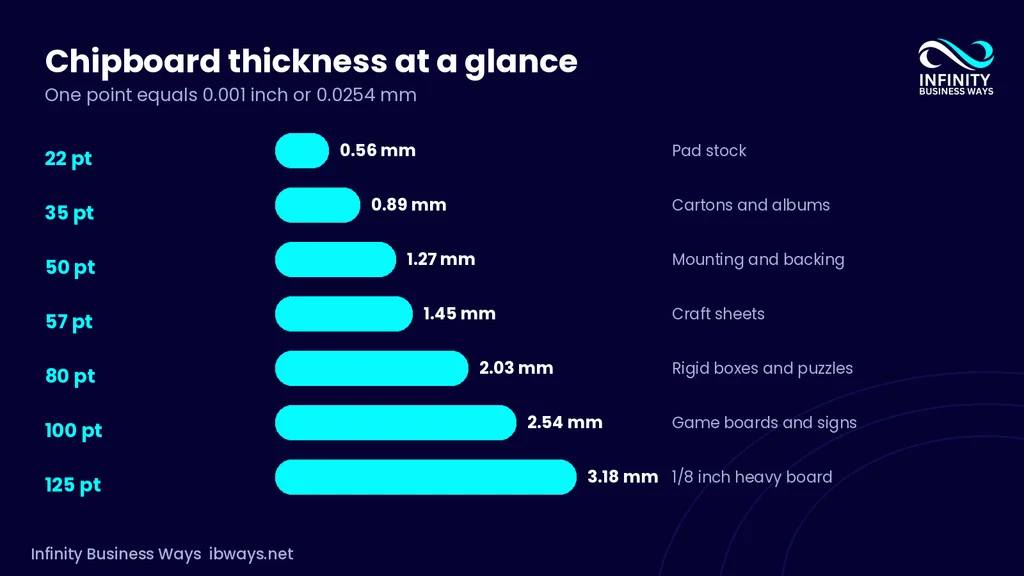
Paper chipboard thickness is called caliper. In North America caliper is given in points, and one point equals 0.001 inch. The usual test method is TAPPI T 411, and suppliers normally allow a tolerance of about 5 percent. See the Lamitech caliper guide and the caliper test method for details.
Quick conversion. Multiply points by 0.0254 to get millimeters. Divide millimeters by 0.0254 to get points. So 80 points is about 2.03 mm, and 2 mm is about 79 points.
| Grade or example | Points | Inches | Millimeters | Typical use |
|---|---|---|---|---|
| Light pad stock, Uline chipboard pads | 22 | 0.022 | 0.56 | Notepad backs, mailer stiffeners, inserts |
| Medium board, LBS chipboard specs | 35 | 0.035 | 0.89 | Folding cartons, albums, notebooks |
| Heavier board from the same supplier range | 42 | 0.042 | 1.07 | Book covers, protective inserts |
| Blick single thick, about 14 ply, Blick chipboard | 50 | 0.050 | 1.27 | Mounting, backing, book making |
| Craft chipboard, natural color, Grafix chipboard | 57 | 0.057 | 1.45 | Scrapbooking, die cutting, painting |
| 60 pt rigid board | 60 | 0.060 | 1.52 | Small rigid boxes |
| 80 pt rigid board | 80 | 0.080 | 2.03 | Strong rigid boxes, puzzles, display backs |
| Blick double thick, about 30 ply, also 100 pt | 100 | 0.100 | 2.54 | Game boards, heavy mounting, signs |
| 1/8 inch chipboard | 125 | 0.125 | 3.18 | Heavy duty crafts and models |
One point equals 0.001 inch or 0.0254 mm.
How Thick Is Chipboard?
Common paper chipboard runs from about 22 points (0.56 mm) for pad stock to 125 points (1/8 inch or 3.2 mm) for heavy board. Craft sheets usually sit between 50 and 100 points. Wood chipboard panels are much thicker, with 18 mm and 3/4 inch (about 19 mm) among the usual sizes.
What Is the Difference Between 80 pt and 100 pt Chipboard?
80 pt chipboard is 0.080 inch or about 2.03 mm thick. 100 pt chipboard is 0.100 inch or 2.54 mm thick. The extra 20 points add about 25 percent more thickness, which makes 100 pt stiffer for puzzles, game boards and display backs.
What Is the Thickness of 1/8 Chipboard?
1/8 chipboard is 0.125 inch thick, which equals 125 points or about 3.18 mm. It is the heaviest size most craft buyers will meet, and it needs a sharp blade and a metal ruler to cut cleanly.
What Does Ply Mean on Chipboard?
Ply names are not a universal standard. Blick lists 14 ply as about 0.05 inch and 30 ply as about 0.10 inch, so two ply or three ply at another store may mean something different. Always compare the thickness in inches, points or millimeters.
Metric Chipboard Thickness
School and craft suppliers outside North America often sell grey chipboard by the micron. Findel grey chipboard offers thin at 1000 microns, medium at 1500 microns and thick at 2000 microns. That equals 1 mm, 1.5 mm and 2 mm, or about 39, 59 and 79 points.
Wood Chipboard Thickness
For floors, Designing Buildings says flooring grade board is usually 18 to 19 mm or 21 to 22 mm thick in 8 ft by 4 ft sheets. In the United States, melamine particleboard commonly comes in 3/4 inch panels that are 4 ft by 8 ft.
Types and Grades of Chipboard
Paper and wood chipboard each come in several grades. Knowing the grade tells you how the board will behave in your project.
Types of Paper Chipboard
- Plain uncoated chipboard. The Blick all purpose board has a smooth uncoated surface on both sides, its color varies with the recycled paper used, and it is not archival.
- White chipboard. White lined chipboard has a clean printable face. Shoppers who search for white cardboard or white chipboard often want this surface.
- Coated and printable chipboard. A clay or polymer coating improves print quality and moisture resistance. Printable chipboard suits packaging mockups and craft templates.
- Laminated chipboard. Several sheets are bonded together for extra stiffness in signs, furniture parts and heavy duty protection.
- Acid free chipboard. Grafix chipboard is acid free and sold in natural, black and white. The natural and black sheets are colored all the way through.
- Kraft chipboard. Kraft colored pads such as the Uline pads above are made of recycled paper and are not acid free.
- Chipboard pads. These are sheets sold in stacks for packing, backing and notepads.
- Light and heavy chipboard. Light chipboard and thin chipboard run about 22 to 30 points. Heavy chipboard starts around 80 points.
Some shoppers call it chipboard paper or paperboard sheets. It behaves like a board, not a paper, so judge it by thickness and finish rather than weight.
Types of Wood Chipboard
In the United States, particleboard follows the ANSI A208.1 standard. It sorts panels by density, with high density generally above 800 kg per cubic meter and medium density generally between 640 and 800. Grades M 2 and M 3 are made for industrial uses such as furniture and cabinets, and PBU is a non structural underlayment grade for floors. Moisture resistant and exterior glue versions exist, though standard board is meant for dry indoor use.
What Is Melamine Faced Chipboard?
Melamine faced chipboard is particleboard with a thermally fused melamine surface on one or both sides. The surface resists scratches, chemicals and stains, so it is popular for cabinet carcases, shelving and shop fixtures. The Home Depot melamine panel is a typical example.
Cut edges have no melamine, so they can chip and absorb moisture. Builders usually seal them with edge banding. The core still swells if it gets wet, which is why standard board is not used outdoors.
Wood panels also fall under United States formaldehyde rules. The EPA formaldehyde rules set a limit of 0.09 ppm for particleboard, and compliant panels must carry a TSCA Title VI or CARB Phase 2 label. Look for that label when you buy.
What Is Chipboard Used For?
Paper chipboard is used for notepad backs, packaging inserts, pallet sheets, book covers, picture frame backing and crafts. Wood chipboard is used for furniture, kitchen cabinets, shelving and floor decking. The right choice depends on material and thickness, so match the board to the job before you buy.
Packaging and Shipping
Chipboard packaging is a big use. Uline says its light pads strengthen envelopes and mailers and add protective layers between items in boxes. Converters also cut chipboard into pallet sheets, edge protectors, dividers and folding cartons for cereal, shoes and toys.
Crafts, Art and Bookbinding
Artists use chipboard for mounting, frame backing and book making. Crafters use chipboard sheets for scrapbook albums, die cut shapes, signs and models. Grafix says its medium weight board can be painted, stamped and sanded and is thin enough for many die cut machines. This works well for chipboard crafts that need body without bulk.
Furniture and Building
Wood chipboard is cheap and flat, which makes it the standard core for flat pack furniture, kitchen unit carcases, shelving and floor decking.
Chipboard vs Cardboard, Paperboard, MDF and Plywood
Several boards look similar but behave very differently. This table shows how chipboard compares with the most common alternatives.
| Material | What it is | Strength and finish | Best for |
|---|---|---|---|
| Paper chipboard | Solid recycled board with no hollow layer | Stiff and smooth, low impact resistance | Backing, inserts, crafts, binding |
| Corrugated cardboard | Flat liners around a wavy fluted layer | Cushions better, less flat | Shipping boxes |
| Paperboard | Wider family of paper boards that includes chipboard | Varies by grade | Cartons and folding boxes |
| Wood chipboard | Wood chips pressed with resin | Lightest and weakest wood fiberboard except insulation board | Budget furniture and carcases |
| MDF | Fine wood fibers pressed with resin | Denser and stronger than particleboard, smooth to paint | Cabinet doors, paint grade parts |
| Plywood | Thin wood layers glued with grain crossed | Stronger than particleboard | Structural and load bearing work |
Strength notes for wood panels come from the particle board overview, which ranks particleboard as the lightest and weakest fiberboard apart from insulation board.
Is Chipboard the Same as Cardboard?
No. Chipboard is a flat, solid board pressed from recycled fiber. Corrugated cardboard has a wavy layer between two flat liners. Chipboard is thinner and smoother, while corrugated board cushions shipments better.
Advantages and Limits of Paper Chipboard
Paper chipboard is a practical, low cost board, but it has clear limits you should know before you buy.
Advantages
- Made mostly from recovered fiber.
- Flat, rigid and consistent in thickness.
- Accepts glue, paint, paper and fabric.
- Easy to cut, score and die cut in lighter grades.
Limits
- Absorbs moisture unless it is coated.
- Less impact resistant than corrugated board.
- Not archival unless the label says acid free.
- Edges can fray when cut with a dull blade.
Is Chipboard Eco Friendly and Recyclable?
Paper chipboard is built from recovered fiber, and paper is one of the most recycled materials in the country. The EPA paper recycling data show that 68.2 percent of paper and paperboard was recycled in 2018, about 46 million tons. Corrugated boxes reached 96.5 percent, while paper packaging other than corrugated boxes reached only 20.8 percent. Coatings, wax and laminates can make recycling harder, so check your local program before you toss coated board.
Is Chipboard Food Safe?
Plain recycled chipboard is not a safe default for direct food contact. Recycled fiber can carry mineral oil from printing inks, and that oil can migrate into dry food. Food packaging usually adds a barrier coating or an inner liner.
France’s food safety agency named printed media entering the recycling chain as the main source of mineral oil in recycled board and recommended functional barriers. Read the ANSES opinion and the EFSA risk assessment for the science. If you pack food, ask your supplier for a food grade specification in writing.
How to Choose the Right Chipboard with the Three Question Check
This quick check takes under a minute and prevents most wrong orders.
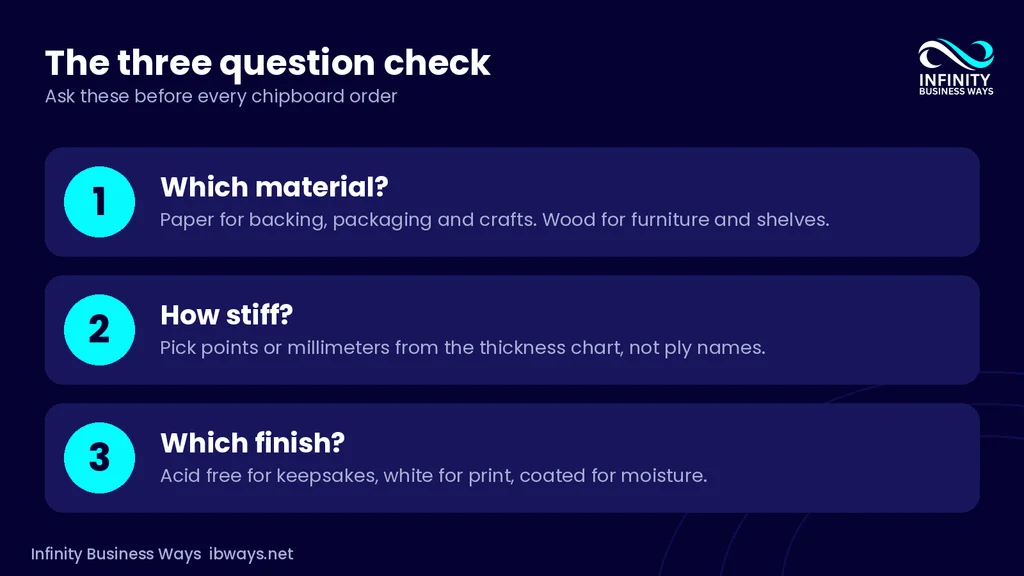
- Which material do I need? Paper for backing, packaging, binding and crafts. Wood for furniture, shelves and floors.
- How stiff must it be? Pick the thickness from the chart above. Use 22 to 30 points for pads and light cartons, 35 to 50 points for covers and albums, and 80 to 125 points for puzzles, games, displays and heavy crafts.
- What finish do I need? Choose acid free for keepsakes, white for clean printing, coated for moisture and plain for everyday backing.
| Job | Best material | Suggested thickness |
|---|---|---|
| Notepad backs and mailer stiffeners | Plain paper chipboard | 22 to 30 points |
| Retail folding cartons | White lined or coated chipboard | 24 to 30 points |
| Book covers and albums | Plain or acid free chipboard | 35 to 60 points |
| Puzzles, game boards and display backs | Heavy paper chipboard | 80 to 100 points |
| Archival mounting | Acid free chipboard | Match the artwork weight |
| Kitchen cabinets and shelves | Melamine faced wood chipboard | 3/4 inch panels |
How to Cut, Glue and Finish Chipboard
A few simple habits give clean cuts and strong joints, whichever type of chipboard you use.
- Cutting. Cut light sheets with a craft knife or heavy scissors. Use a sharp blade and a metal ruler for heavy sheets, and make several light passes instead of one hard one.
- Gluing. The LBS spec sheet lists protein, PVA, polyurethane and hot melt adhesives as acceptable. Use archival grade adhesive for keepsakes.
- Finishing. Seal the edges and prime the surface before painting to limit warping. Wood chipboard is rough and porous, so it usually needs two or three coats of primer.
- Storage. Keep sheets flat and dry so they do not warp.
Best Places to Buy Chipboard by Intent
The best seller depends on what you are making. Stock, sizes and prices change often, so open the live product page and check the thickness and material line before you order.
| Your intent | Good fit | Why it fits |
|---|---|---|
| Art mounting, backing and book making | Blick chipboard | Single thick (0.05 inch, about 14 ply) and double thick (0.10 inch, about 30 ply) sheets in 22 x 28 in and 28 x 44 in sizes. Listed as not archival. |
| Scrapbooking and die cutting | Grafix chipboard | Acid free sheets in natural, black and white in 4 x 6 in, 6 x 6 in, 8.5 x 11 in and 12 x 12 in sizes. |
| Packaging, mailers and bulk pads | Uline chipboard pads | 0.022 inch recycled pasteboard pads sold by the case in many sizes. SFI certified and not acid free. |
| Bookbinding and rigid box makers | LBS chipboard specs and CFS Products | LBS lists calipers of .022, .035 and .042 and full size sheets made in the USA. CFS sells 22 point sheets in boxes of 200. |
| Cabinets, shelves and furniture | Home Depot melamine panel | Melamine particleboard in 3/4 inch, 4 ft by 8 ft panels with a panel saw service in many stores. |
| UK schools and class projects | Findel grey chipboard | A1 grey chipboard in thin, medium and thick weights in packs of 10 sheets. |
| Wholesale and custom sizes | Packaging converters and local board suppliers | Ask for caliper in points, grain direction, minimum order size and whether the board is acid free or food grade. |
Common Mistakes When Buying Chipboard
Most chipboard buying problems come from the same seven mistakes.
- Buying the wrong meaning. Check whether the listing is paper or wood.
- Mixing up units. Compare points, inches and millimeters before you order.
- Trusting ply counts. Ply is not a universal standard.
- Using plain board for keepsakes. Choose acid free instead.
- Using plain board for food. Ask for a food grade barrier.
- Skipping the label on wood panels. Look for TSCA Title VI or CARB Phase 2 compliance.
- Buying MDF by accident. Some craft listings call quarter inch MDF chipboard.
Final thought on Chipboard and FAQs
Chipboard is simple once you know which kind you need. Decide between paper and wood, pick the thickness in points or millimeters, then choose the finish. Run the three question check before every order and you will avoid the wrong board, the wrong thickness and the wasted shipping.
Bookmark this guide for your next project and share it with anyone who keeps asking what chipboard really is.
Frequently Asked Questions
How much does chipboard cost?
Price depends on thickness, sheet size and order quantity, so compare cost per sheet at the same point thickness. Thicker and larger boards cost more, and bulk cases usually cut the unit price.
Can you screw into wood chipboard?
Yes, but the core is crumbly. Drill a pilot hole, use coarse thread screws made for chipboard and stay away from the edges, where the panel splits most easily.
Can chipboard grow mold?
Yes, if it stays damp. Wood chipboard swells and paper chipboard softens when wet, and both can mold, so dry the board fast and store it somewhere ventilated.
What is the difference between chipboard and OSB?
OSB is made from larger wood strands laid in oriented layers, which makes it stronger and better for wall and roof sheathing. Chipboard uses smaller particles and suits furniture and shelving.
Is chipboard the same as hardboard?
No. Hardboard is a thin, very dense fiberboard made from wood fibers, so it is smoother and stronger than chipboard. Wood chipboard is thicker, lighter and weaker.
How do I dispose of chipboard?
Clean uncoated paper chipboard can go with paper recycling where accepted. Coated, wet or glued board may not qualify. Wood chipboard usually goes to a waste or wood recycling center, so check local rules.