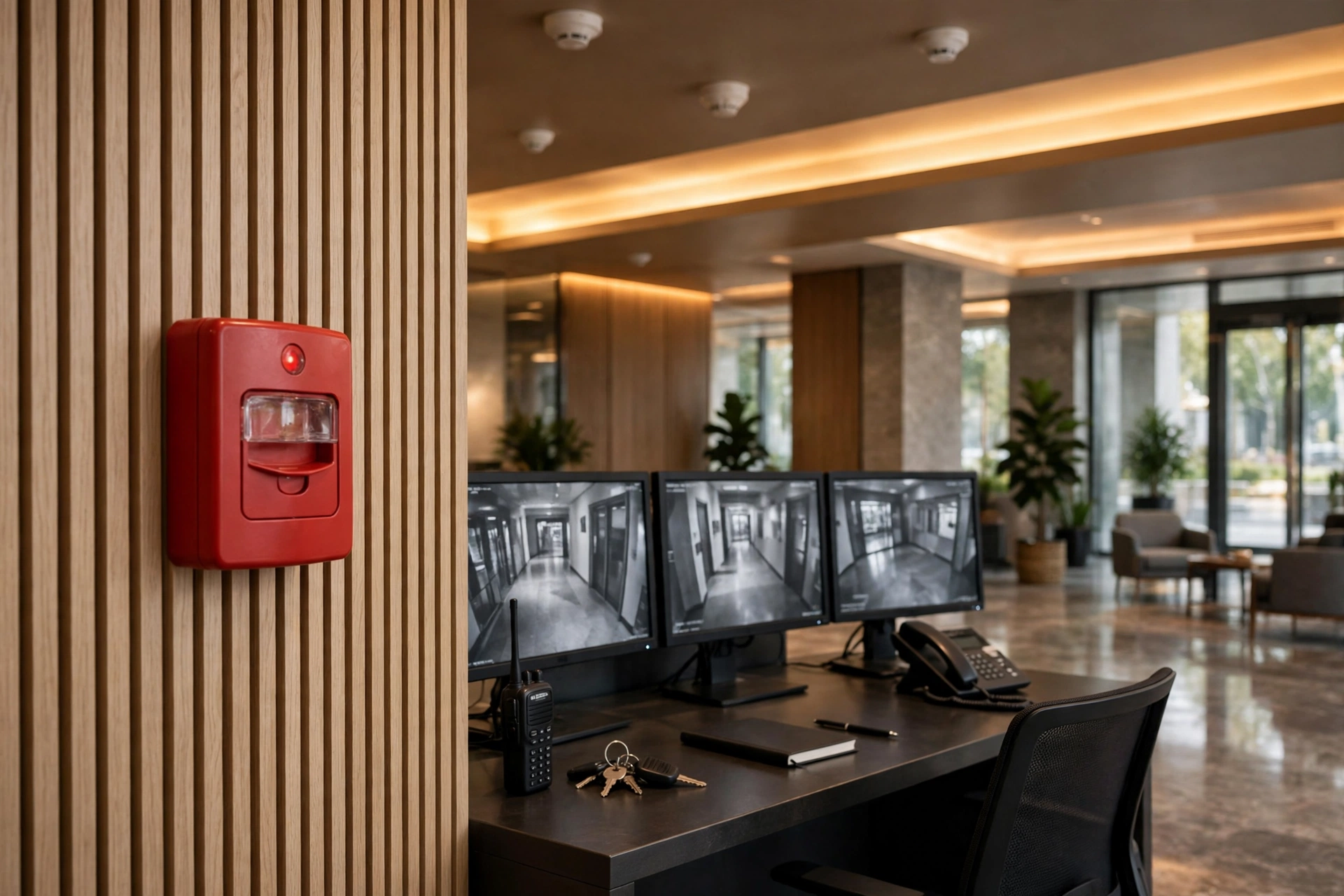
Fire Alarm Monitoring Costs and Vital Building Safety Rules
Fire alarm monitoring is a service that sends signals from a fire alarm control panel to a monitoring station located off site. A local alarm sounds only inside the building, so it can go unheard when the premises is empty. A monitored system adds a second path that brings the signal to people who can act on it.
The rules for this service sit in the supervising station definition chapter of NFPA 72, the National Fire Alarm and Signaling Code. That chapter explains how signals must be received, handled and retransmitted. Monitoring also reports faults such as a failed communication path or a power problem, so owners can repair the system before a real fire tests it.
Table of Contents
Monitored Fire Alarm Versus a Local Alarm
A monitored fire alarm reaches help whether or not anyone is in the building. A local alarm depends on someone hearing it and calling for help.
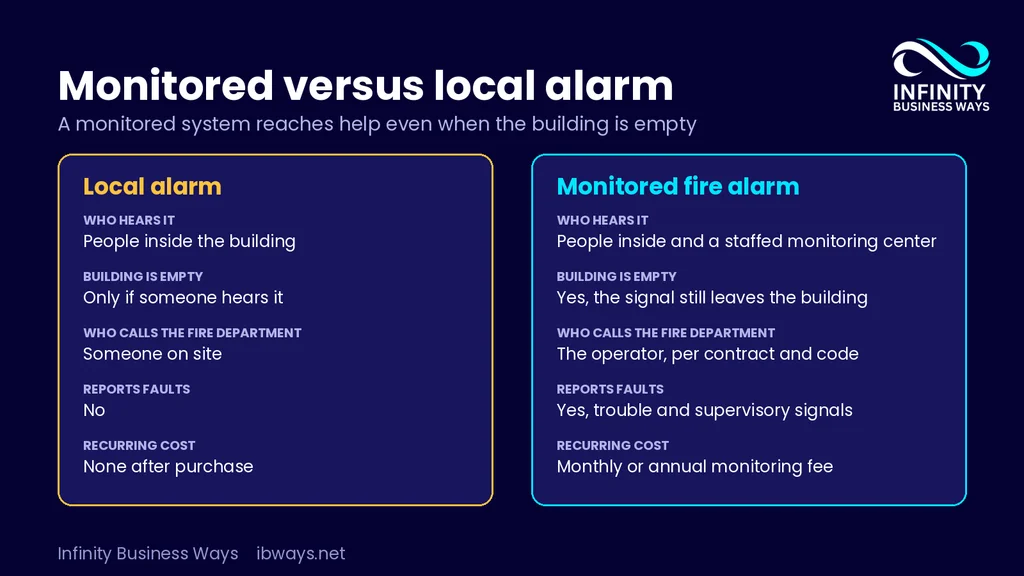
The Telsco monitoring guide describes monitored smoke detectors as devices that send alarms to a monitoring center as well as sounding locally. That extra step lets operators act on the owner’s behalf when the owner cannot.
How Fire Alarm Monitoring Works
A monitored system moves a signal through four links, from the detector on the ceiling to a trained operator.
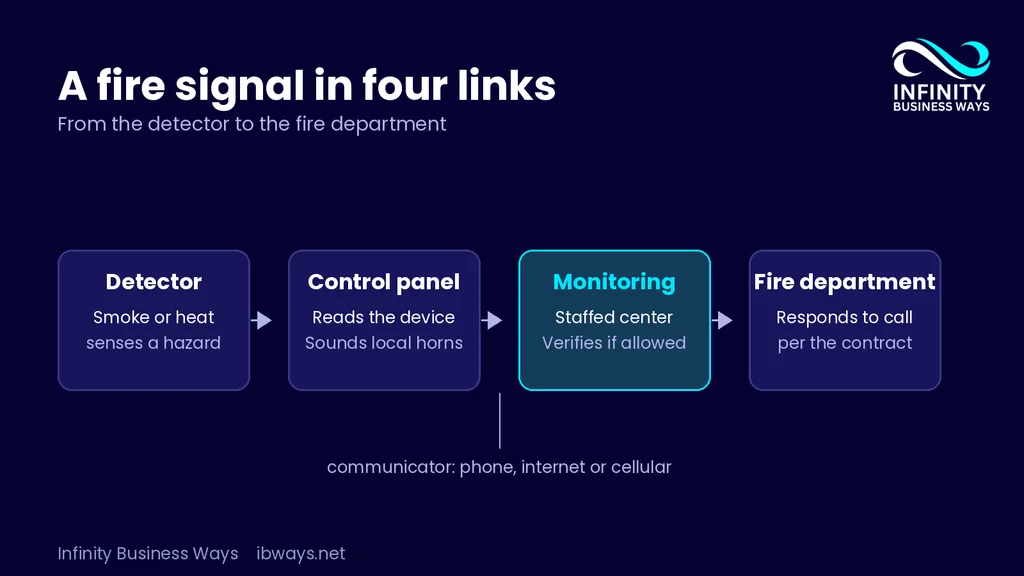
- Detection. A smoke detector, heat detector, sprinkler waterflow switch or manual pull station starts the process.
- Panel processing. The control panel reads the device, sounds horns and strobes on site, and prepares the signal.
- Transmission. A communicator sends the signal over a phone line, an internet connection or a cellular network.
- Response. An operator logs the event, verifies it when the procedure allows, and notifies the fire department or the designated contacts.
Alarm, Supervisory and Trouble Signals
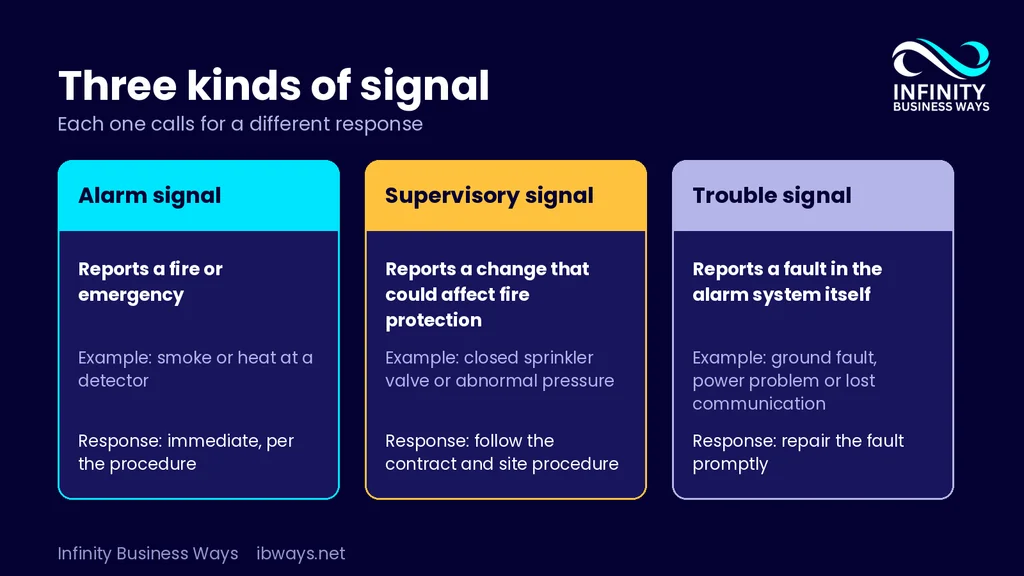
Monitoring centers receive three main signal types, and each one calls for a different response.
The three signal types and what each one reports
A trouble signal does not mean a fire is burning, but it can mean the system will not work when it is needed. One fire alarm signal guide describes a trouble condition as an abnormal condition within the system itself, such as a ground fault.
What Happens in the First Minute
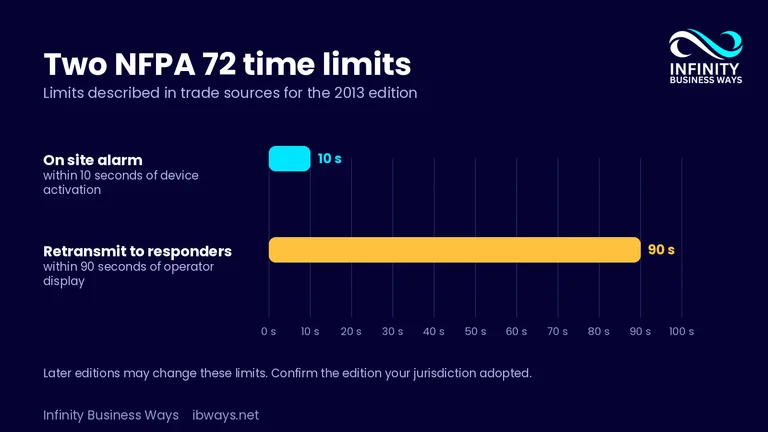
NFPA 72 sets strict timing for monitoring centers. The 2013 edition required a supervising station to retransmit an alarm to emergency responders within 90 seconds of an operator displaying it, including any verification step, as the NFPA rule update analysis explains. Later editions may change that limit, so confirm the edition your jurisdiction has adopted.
Two time limits from NFPA 72 as described in trade sources
On the building side, the code expects an alarm signal to occur within 10 seconds after a device activates, as the Culver City fire notes describe. Taken together, these limits mean the full chain can take up to about 100 seconds under the 2013 rules.
Is Fire Alarm Monitoring Required?
Whether monitoring is mandatory depends on the building’s use, the adopted fire code and the authority having jurisdiction, which is the fire marshal or building official who approves the system. NFPA 72 defines how monitoring must perform once it is installed, while local rules decide whether it must be installed at all.
When Commercial Buildings Must Be Monitored
Many commercial buildings must be monitored because the code calls for automatic notice to the fire department. NFPA 101 Section 9.6.4.2 asks fire alarm systems to transmit notice of a fire automatically to the municipal fire department, unless the system uses a positive alarm sequence or staff can promptly notify the department. The Koorsen monitoring requirements article explains that a building with a positive alarm sequence or trained staff on site may not need outside monitoring.
Local rules can go further. Henderson, Nevada, requires monitoring facilities to hold a fire safety permit before they connect a subscriber, and the Henderson fire safety guideline sets out that process. Always confirm the rule with your own fire department.
Does a Home Fire Alarm Need Monitoring?
Most homes are not required to have monitored systems, but monitoring adds protection when nobody is there to respond. Many houses rely on standalone smoke alarms that sound only inside the home.
The value of working alarms is well documented. An NFPA smoke alarm report analyzed more than 1.7 million home fires from 2012 to 2016 and found that the risk of dying in a home fire was 54 percent lower where working smoke alarms were present. Alarms were absent in 40 percent of fatal home fires and failed to operate in 17 percent of them. In the cases where an alarm malfunctioned, 43 percent had missing or disconnected batteries.
Monitored smoke detectors close the gap when a family is asleep or away. NFPA recommends testing smoke alarms at least once a month, and monitoring does not remove the need for that routine test.
Central Station, Remote Station and Proprietary Monitoring
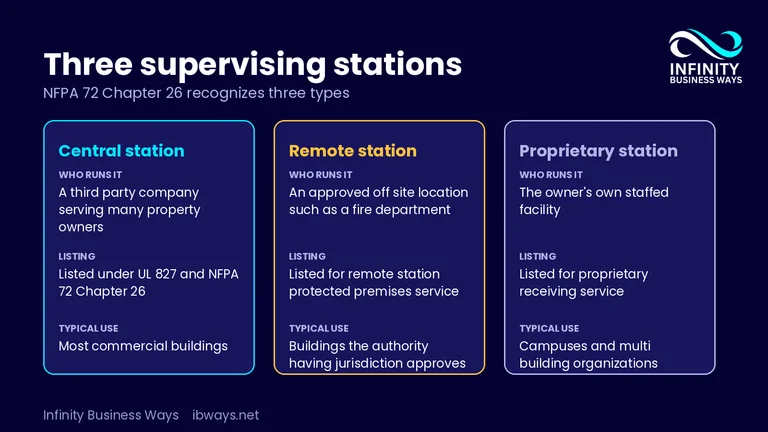
NFPA 72 recognizes three types of supervising stations. The type you choose decides who monitors your alarms and which listings must apply.
The three supervising station types under NFPA 72 Chapter 26
A generic call center does not qualify on its own. Only a listed facility that provides central station service under NFPA 72 and UL 827 counts as a central station. Ask for proof of listing before you sign, and read the UL central station guidance to see how fire officials verify the service.
Fire Alarm Monitoring Cost
For commercial buildings, monthly monitoring usually falls between $50 and $100, while installation depends far more on building size, device count and wiring. The Mammoth Security cost guide gives the same monthly range, notes that contracts can run from one to five years, and puts basic small business systems between $1,500 and $3,500 to install.
| Source | Setup or installation | Monthly monitoring | Contract terms |
| Mammoth Security guide | Basic small business systems from $1,500 to $3,500 | $50 to $100 for commercial properties | Often one to five years |
| Alarm Relay commercial plan | $35 one time setup fee | From $29.95 for fire monitoring | No long term contract for commercial accounts |
| Cal West Fire Alarm Service | Call for an estimate | From $28 per month | Not stated in listing |
| ThePricer commercial estimate | Varies by system | About $50 to $60 per month | Multi year contract |
These are published price points from individual providers, not independent averages. The lowest advertised rate is a starting point, because it often leaves out setup, panel programming or a longer term.
Three year monitoring totals computed from published monthly and setup prices
Multiply the monthly fee by the contract length and add any setup fee. A $30 plan with a $300 setup fee costs $1,380 over a three year term, which is the number to compare.
Benefits of Commercial Fire Alarm Monitoring
Monitoring pays off most when a building sits empty for long stretches, or when a fire would destroy stock, equipment or business activity. Four benefits stand out.
- Off hours protection. A warehouse, office or school may have no one present for many hours each night, and a local alarm alone leaves that whole period unwatched.
- Faster notice of a fire. The signal path and operator procedure replace the delay of someone spotting smoke and dialing.
- Early fault reports. Trouble and supervisory signals warn an owner about a lost communication path, a power problem or a closed sprinkler valve before a fire tests the system.
- Insurance and compliance support. Some insurers ask for proof that a building is monitored.
Ask your insurer which monitoring certificate it accepts before you choose a provider.
False Alarms and Verification
False alarms are the most common complaint about monitoring, and they carry real costs. The Statista false alarm data, which draws on NFPA figures, shows that U.S. fire departments responded to 2,889,000 false alarms in 2018.
Most false alarms are not pranks. Illinois fire officials told the Daily Herald false alarms report that most point to a maintenance problem in the alarm or suppression system. Many fire agencies charge fines that start near $100 and grow when the same problem repeats.
Verification is the main tool monitoring centers use to cut unnecessary dispatches. Where the fire department requires it, NFPA 72 allows an optional verification procedure, which the 2013 edition limited to 90 seconds. Addressable panels help too, because they identify the exact device that activated, so responders know where to look.
Equipment in a Monitored Fire Alarm System
- The control panel receives every device signal, runs the programmed responses and reports faults.
- Smoke detectors sense particles in the air. Heat detectors respond to a set temperature or a fast rise in temperature.
- Manual pull stations let a person start the alarm at the first sign of fire.
- The communicator sends signals by phone line, internet or cellular network. The NFPA 72 committee report covers the approved communication methods in Chapter 26.
- Backup power keeps the panel running during an outage. Confirm the standby period with your installer.
A failed communicator is a serious gap, because the panel can keep working while the monitoring center stops receiving signals.
How to Choose a Fire Alarm Monitoring Company
The right provider depends on what your building needs, so match the service type to your situation before you compare prices.
| Your situation | Best fit | What to verify |
| Commercial building with a code requirement | UL listed central station | Listing for central station service under NFPA 72 Chapter 26 |
| Campus or organization with several buildings | Proprietary supervising station | Facility listed for proprietary receiving service |
| Building approved to use a fire department or other approved site | Remote supervising station | Listing for remote station protected premises service |
| Homeowner or small apartment | Monitored smoke detectors or a residential plan | Monthly fee, cancellation terms and cellular backup |
| Small business seeking a low monthly rate | Month to month commercial plan | Listing, response procedure, setup fee and extra charges |
Searches for fire alarm monitoring near me often return local installers. Ask whether the company monitors the system itself or sends signals to a listed central station. Either model can work, but you should know which one you are buying before you sign.
Questions to Ask Every Provider
- Is your central station listed to UL 827, and can you show the listing and certificate number?
- Which NFPA 72 supervising station type do you provide, and is it listed for that service?
- How do you verify alarms, and how fast do you retransmit them to the fire department?
- Which communication paths do you use, and is there cellular or internet backup?
- Who handles trouble and supervisory signals after hours, and what happens next?
- What are the setup fee, monthly fee, contract length and cancellation cost?
- How often is the call list updated, and who can change it?
- Will you provide a monitoring certificate that my insurer accepts?
Testing and Maintenance That Keeps Monitoring Reliable
Monitoring only works when the alarm system itself is tested and maintained. The Culver City fire notes require inspection, testing and maintenance to follow Chapter 14 of NFPA 72 and the manufacturer’s specifications. Ask your provider how often it runs communication tests, because a silent communicator stops every signal without any visible sign on site.
Changing monitoring companies also takes planning. Some fire departments require a witnessed test whenever the central station changes, as Culver City does, so schedule that test before you switch.
Final Thought and Fire Alarm Monitoring FAQs
Fire alarm monitoring turns a local alarm into a system that reaches help around the clock. Owners who understand signal types, code requirements and contract terms can choose a provider with confidence. Start by confirming whether your building must be monitored, match the station type to your code, and compare the three year cost rather than the monthly rate alone.
If you are unsure which rules apply, contact your local fire marshal or authority having jurisdiction before you sign anything. Their answer decides what your system must do.
FAQs
What is a monitored fire alarm?
A monitored fire alarm sends alarm, supervisory and trouble signals from the control panel to a staffed monitoring center. The center responds according to the contract and code, so the alert does not depend on someone hearing the alarm inside the building.
Does a fire alarm system have to be monitored?
It depends on the building, its use and the locally adopted fire code. Many commercial buildings must be monitored, while many homes rely on standalone smoke alarms and some add monitored detectors by choice.
When is fire alarm monitoring required?
Monitoring is commonly required when no staff can promptly notify the fire department and the system lacks a positive alarm sequence, under the NFPA 101 rule. Local codes, insurers and the authority having jurisdiction can add their own requirements.
What does fire alarm monitoring cost per month?
Commercial monitoring commonly ranges from about $50 to $100 per month, and some providers advertise entry plans near $30. Setup fees, contract length and cancellation terms can change the total more than the monthly rate does.
How fast does a monitored fire alarm reach the fire department?
Under the 2013 edition of NFPA 72, an alarm had to occur on site within 10 seconds of device activation, and the supervising station had to retransmit it within 90 seconds of operator display. Later editions may differ, so confirm the edition your jurisdiction adopted.
Sources
Sources checked as of October 16, 2026. Price figures are published by individual providers, and code references follow the NFPA editions named in each source.
- Mammoth Security cost guide for installation and monitoring ranges
- Alarm Relay commercial plan for a published commercial price and contract terms
- ThePricer commercial estimate for installation cost per square foot
- Koorsen monitoring requirements for the NFPA 101 monitoring rule
- Henderson fire safety guideline for a local permit example
- Culver City fire notes for NFPA 72 timing and testing references
- NFPA rule update analysis for the 2013 verification and retransmission limit
- supervising station definition for NFPA 72 supervising station types
- UL central station guidance for central station listing and authority roles
- NFPA 72 committee report for communication methods and listing text
- fire alarm signal guide for alarm, supervisory and trouble conditions
- NFPA smoke alarm report for home smoke alarm outcomes
- Statista false alarm data for 2018 false alarm responses
- Daily Herald false alarms for fire department views on false alarms
- Telsco monitoring guide for how monitored smoke detectors work