
Commercial Movers Guide to Costs, Packing and Moving Rules 2026
A commercial mover is a professional moving company that relocates offices, stores, warehouses and other business sites. Unlike a home mover, a commercial mover plans around work hours, building rules, IT equipment and bulk inventory. Services often include packing, furniture setup, transport, storage and removal of surplus assets.
This guide goes further than most. Besides costs and services, it covers packing materials, loading docks, pallet jacks and returns, because those details decide whether a business move stays on time and on budget.
Key Takeaways
Read these six points first if you are short on time.
- Most small local office moves are quoted between about $1,000 and $5,000, although one source runs far wider.
- Interstate movers must be registered with FMCSA and hold a USDOT number, so verify before you sign.
- Standard docks are 48 inches high while many box trucks sit lower, so plan a dock plate, ramp or lift gate.
- Electric walkie pallet jacks count as powered industrial trucks under OSHA, so operators need training.
- Gaylord boxes, chipboard pads, poly bags and packing peanuts each protect a different kind of item.
- Returns, surplus furniture and old electronics need a plan before moving day.
Table of Contents
Commercial Mover vs Residential Mover
Both move belongings, but a commercial mover works under tighter schedules, bigger loads and stricter building rules.
Scale is the clearest difference. Suddath Office Moving reports moving 135 million square feet of space and 674,000 workstations a year for about 2,700 customers, which shows how much planning a large business move needs.
| Feature | Commercial mover | Residential mover |
|---|---|---|
| Scope | Offices, stores, warehouses, clinics and labs | Homes and apartments |
| Schedule | Nights, weekends and phased moves that protect work hours | Mostly daytime single day moves |
| Equipment | Pallet jacks, dock plates, crates and floor protection | Dollies, blankets and straps |
| Goods | IT gear, files, inventory, fixtures and shelving | Furniture and household items |
| Paperwork | Insurance certificates, building rules and dock bookings | Basic estimate and inventory |
| Pricing | Hourly, per square foot, per workstation or by quote | Hourly or by weight |
Commercial Moving Services Explained
Commercial moving services range from a simple truck and crew to full relocation management. Match the service to your risk, not just your budget.
Movers also serve many sectors. The company Two Men And A Truck lists schools, hospitals and design firms among the business types it moves on its business page.
| Service | What it covers |
|---|---|
| Office moving and relocation | Planning, packing, furniture disassembly, transport and setup at the new space |
| Retail and store moves | Fixtures, shelving, stock and displays moved in a short closing window |
| Warehouse and industrial moves | Palletized goods, racking and heavy equipment, often with pallet jacks and forklifts |
| Medical and lab moves | Sensitive devices, records and equipment that need careful handling |
| IT and workstation moves | Computers, phones, servers and cabling reconnected desk by desk |
| Storage | Short term holding between a lease ending and a new space opening |
| Packing and crating | Boxes, crates, labels and wrap supplied and packed by the crew |
| Disposal and liquidation | Removal or resale of surplus furniture and electronics |
How Much Does a Commercial Move Cost?
Most small local office moves cost about $1,000 to $5,000, medium offices about $5,000 to $15,000 and large offices from $15,000 to $30,000 or more. Prices depend on size, distance, access, IT work and timing, so treat published ranges as a starting point and get written quotes.
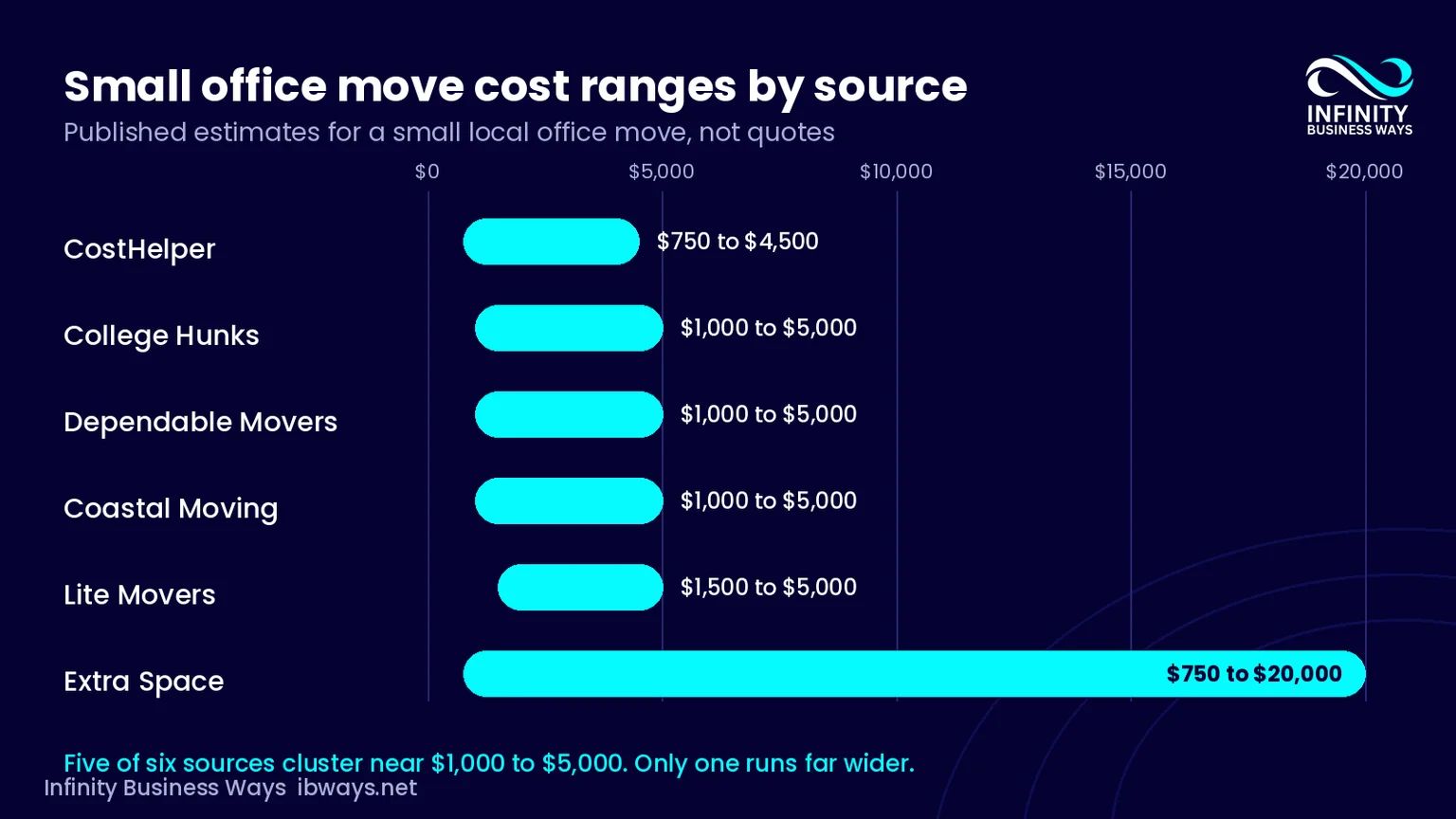
Published estimates for a small local office move. These are ranges, not quotes.
Published Cost Ranges by Office Size
| Source | Small office | Medium office | Large office |
|---|---|---|---|
| College Hunks cost report | $1,000 to $5,000 (up to 10 employees) | $5,000 to $15,000 (10 to 100 employees) | $15,000 to $30,000+ (200+ employees) |
| Coastal Moving data | $1,000 to $5,000 (1 to 10 employees) | $5,000 to $15,000 (20 to 50 employees) | $15,000 to $30,000+ (100 to 200 employees) |
| Lite Movers costs | $1,500 to $5,000 (under 1,000 sq ft) | $5,000 to $20,000 (1,000 to 10,000 sq ft) | $20,000+ (10,000+ sq ft) |
| CostHelper office mover | $750 to $4,500 (1,500 sq ft) | $1,500 to $9,000 (3,000 sq ft) | $5,000 to $30,000+ (10,000 sq ft) |
The sources agree more than they differ. The wide gaps come from what each estimate includes, such as packing, IT work and building fees.
What Drives the Price
- Headcount and workstations. CostHelper puts a move at $50 to $250 or more per employee.
- IT relocation. Coastal Moving cites Angi data adding $5,000 to $10,000 for a typical 30 person office, and CostHelper puts cabling and moving for a 10 person office near $4,000.
- Access. Long carries, stairs and elevator waits add crew hours.
- Timing. After hours work and busy summer months usually cost more.
- Packing and storage. Materials, crates and holding time are often priced separately.
Typical Hourly Rates
Dependable Movers guide lists $50 to $100 per hour per mover, while Three Movers puts a two man crew with a truck at $100 to $175 per hour. Rates vary by city and season, so compare the full written scope, not just the hourly number.
A Simple Budget Formula
Add labor (movers times hours times hourly rate), truck and fuel, packing materials, IT and cabling, building fees and insurance, then add a 10 percent buffer. As an illustration, four movers for 8 hours at $75 an hour is $2,400. Add $600 for the truck and $400 for packing materials, then a 10 percent buffer, and the budget is $3,740.
Commercial Moving Timeline and Checklist
Good office relocation planning starts about 12 weeks out. This timeline keeps downtime short and avoids last minute surprises.
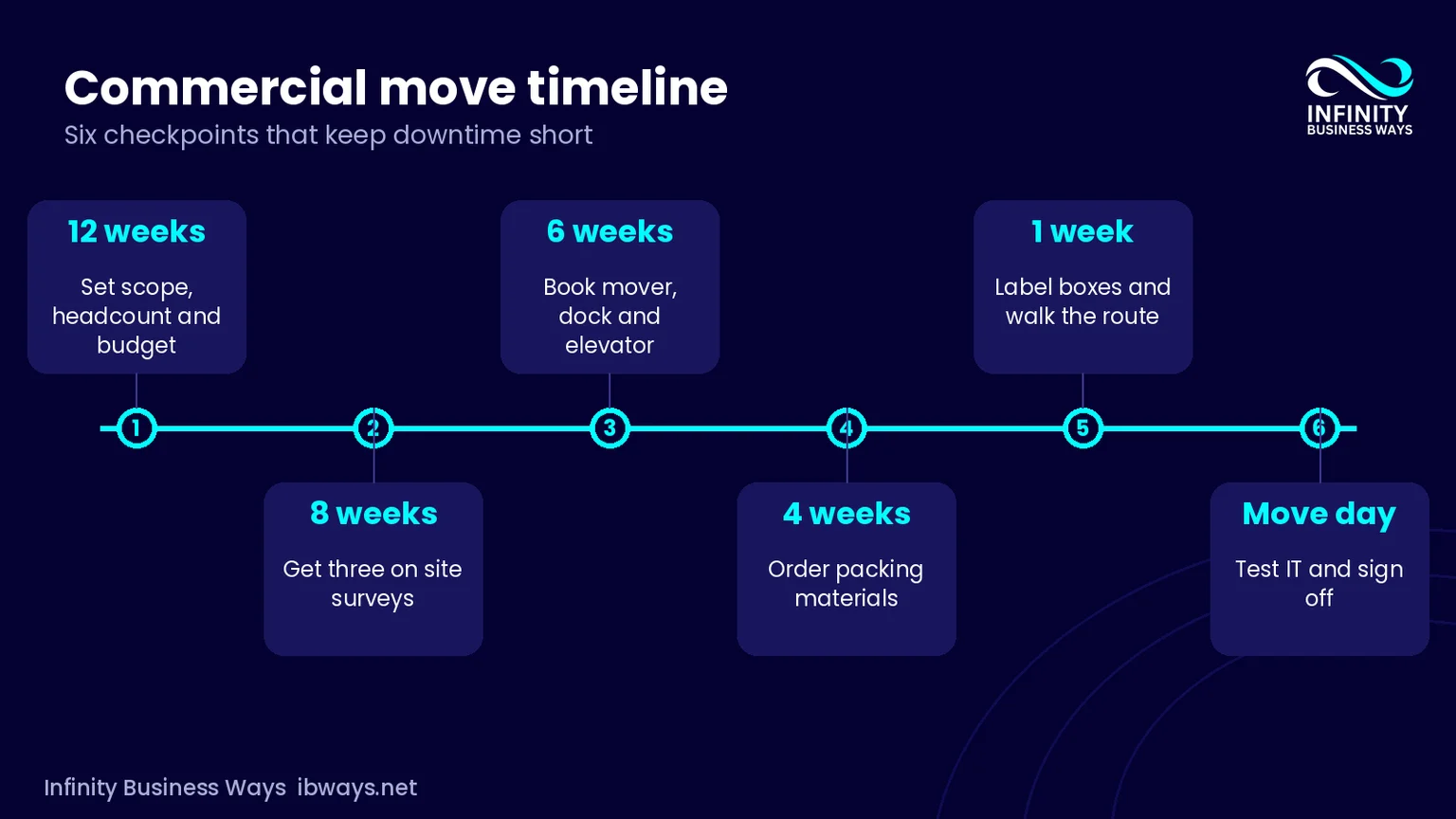
| When | What to do |
|---|---|
| 12 weeks | Set the scope, headcount, budget and move date. Tell your landlord and building manager. |
| 8 weeks | Request three on site surveys and compare written estimates line by line. |
| 6 weeks | Book the mover, the dock window and the freight elevator. Ask for the mover’s insurance certificate. |
| 4 weeks | Order packing materials, name a move coordinator and plan the new floor layout. |
| 1 week | Label every box with a department and desk code, back up data and walk the route with the crew lead. |
| Move day | Check the inventory, test phones and network, and sign off on the delivery paperwork. |
How to Choose a Commercial Moving Company
The cheapest quote is rarely the safest. Score every commercial moving company on the same points before you decide.
The Seven Point Mover Scorecard
| Check | Points | What to look for |
|---|---|---|
| Licensing | 20 | Interstate movers need FMCSA registration and a USDOT number. Local movers need any state license your state requires. |
| Insurance | 20 | A current insurance certificate with clear coverage limits that match your equipment value. |
| On site survey | 15 | A walk through of your space. Pricing from a phone call alone often misses stairs, elevators and access. |
| Written estimate | 10 | Clear scope, rates and exclusions. Ask what counts as extra work. |
| References | 15 | Recent moves for businesses of your type and size. |
| Equipment | 10 | Dock plates, pallet jacks, floor protection and crates available on the day. |
| Claims record | 10 | A stated claim rate and a clear claims process. |
Total the points out of 100. Treat any mover scoring below 70 as a warning sign.
Verify Interstate Movers
Interstate movers must be registered with the Federal Motor Carrier Safety Administration and have a USDOT number, and brokers must be registered too. Check both on Protect Your Move and read the FMCSA movers fact sheet. Those consumer guides focus on household moves, so a business should lean even more on a detailed contract and proof of insurance.
Providers by Intent
Different buyers need different movers. These examples come from each company’s own website and are not rankings or paid placements.
| Your intent | Example provider | What the company says |
|---|---|---|
| Large multi site corporate moves | Suddath office moving | Operating since 1919 and reports 135 million square feet and 674,000 workstations moved a year. |
| Texas business moves with hourly pricing | 3 Men Movers | In business since 1985, reports a claim rate under 2 percent and uses hourly pricing with a 2 hour minimum. |
| Established metro movers | Clancy Moving | Says the company started in 1959 and offers commercial moves. |
| Regional full service moves | Stewart Moving | Explains that pricing starts with an on site survey and mentions setting up technology at desks. |
| Schools, medical sites and design firms | Two Men movers | Lists these business types among the clients it serves. |
Run the scorecard on any of them, because claims on a website are not proof.
Packing Materials for a Commercial Move
Different items need different protection. These four materials cover most office and warehouse needs, and each one has its own guide on our site.
Chipboard Pads and Dividers
Light chipboard pads add stiffness and separate layers of paper goods, frames and boxed items. The Uline chipboard pads are 0.022 inch recycled pasteboard and are not acid free, so keep them away from archives.
Gaylord Boxes for Bulk Loads
A Gaylord box has a 48 by 40 inch footprint that matches a standard pallet. The Uline Gaylord box is double wall, rated 51 ECT and meets ASTM D5118, while triple wall versions from packaging suppliers are rated for about 1,100 to 1,300 pounds. Use them for bulk files, parts and soft goods and never double stack them. See our guide on Gaylord boxes for sizes.
Poly Bags and Poly Bagging
Poly bags keep screws, cables and small parts organized, and anti static versions protect electronics. Stock bags run from 1 to 6 mil, where one mil is one thousandth of an inch. See the Uline bag guide and the mil thickness guide. Thin Poly bags of 1 mil or less usually need a printed warning under suffocation warning rules.
Packing Peanuts and Void Fill
Packing peanuts fill gaps around fragile items. Traditional peanuts are polystyrene while starch peanuts dissolve in water, so a quick water test tells them apart. Earth911 peanut recycling says the EPS Industry Alliance lists over 680 drop off sites because curbside programs rarely accept them.
Which Material for Which Item
| Item | Best material | Why |
|---|---|---|
| Computers and monitors | Original box or molded foam and anti static bags | Shock and static protection |
| Files and binders | File boxes, or Gaylord boxes for bulk archives | Keeps weight on a pallet footprint |
| Cables, screws and hardware | Labeled poly bags | Keeps parts matched to each desk |
| Small fragile items | Void fill such as peanuts or paper | Stops items shifting in transit |
| Framed art and glass | Chipboard sheets and corner protection | Adds a stiff layer between pieces |
Uline lists Gaylord boxes, chipboard pads and poly bags, which makes it a simple first stop for all three. Compare thickness and size before you order.
Shipping Dock and Loading Dock Planning
The loading dock decides how fast a move goes. A mismatch between the dock and the truck can stop work before it starts.
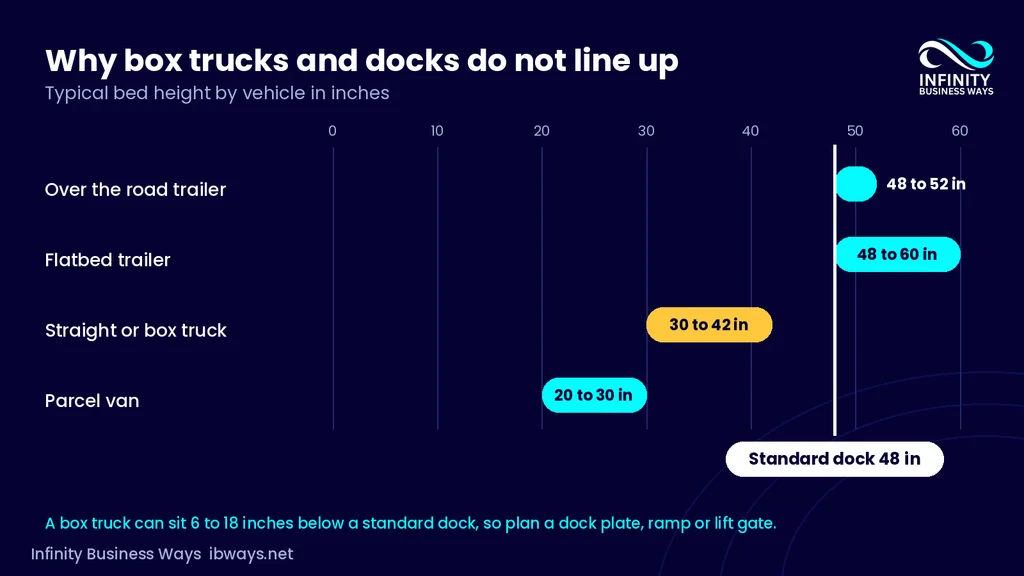
Dock Height and Truck Match
The loading dock guide says the standard dock height in North America is 48 inches, which matches most over the road trailers at 48 to 52 inches. Straight and box trucks sit lower at 30 to 42 inches, so movers often need a dock plate, ramp or lift gate.
Dock Safety Basics
OSHA has no single dock standard, but several rules apply. Open dock edges of 4 feet or more need fall protection, and trailers must be secured with chocks or restraints before a lift truck enters. The dock safety guide notes that about a quarter of warehouse injuries happen on or near docks.
Questions to Ask the Building
- What are the dock height and door width?
- What is the leveler capacity?
- How long is the booking window and can it run after hours?
- What are the freight elevator size and hours?
- What insurance certificate does the building require?
- Where can crates and pallets be staged?
Walkie Pallet Jacks and Moving Equipment
Warehouse and industrial moves rely on pallet jacks. Knowing the rules helps you judge whether a mover is prepared.
What a Walkie Pallet Jack Does
A walkie pallet jack is an electric, walk behind truck that lifts and moves pallets. Typical models carry about 4,400 to 4,500 pounds on 27 by 48 inch forks, as in the Crown walkie specs. Movers use them at docks and in stock rooms. Read our walkie pallet jack guide for sizing.
OSHA Training Rules
Powered pallet trucks fall under OSHA’s powered industrial truck standard. Operators must be trained and evaluated at least once every three years, according to the OSHA operator training rules. Manual jacks have no motor, so this standard does not cover them.
What to Ask Your Mover
- Who will operate the equipment and where are their training records?
- What is the floor and elevator weight limit at both sites?
- Do you bring your own pallet jacks and dock plates?
Reverse Logistics in an Office or Warehouse Move
Reverse logistics is the process of moving goods from their final destination back through the supply chain to recapture value or dispose of them properly, as in this reverse logistics definition. In a business move it covers returns, surplus furniture, old electronics and unsold stock.
Why Returns Matter Before You Move
The NRF returns report expects U.S. retailers to see $849.9 billion in returns in 2025, about 15.8 percent of sales and 19.3 percent of online sales. A retail or ecommerce warehouse often holds a returns backlog, and moving it unsorted wastes space and money.
A Five Step Plan
- Audit. List every returned, surplus and end of life item.
- Sort. Decide to resell, refurbish, recycle or dispose.
- Label. Tag each pallet with its outcome.
- Schedule. Book pickups before the main move.
- Record. Keep receipts for recycling and disposal.
Commercial Mover Mistakes to Avoid
Most failed business moves share the same few errors. Avoid these seven.
- Choosing on price alone. Use the scorecard instead.
- Skipping the on site survey. Hidden access problems become extra charges.
- Forgetting the dock and elevator. Book both with the mover.
- Ignoring IT downtime. Plan cabling and network tests early.
- Using the wrong packing material. Match the item to the material.
- Ignoring returns and surplus. Clear them before the move.
- Not verifying registration. Check interstate movers on FMCSA tools.
Final Words and FAQs
A good commercial mover is only part of a successful business move. The dock, the pallet jacks, the packing materials and your plan for returns decide whether the day runs smoothly.Bookmark this guide, run the scorecard on every quote and share it with the person who owns your next move.
FAQs
How long does an office move take?
Three Movers says many local commercial jobs take 6 to 12 hours and long distance moves can take 3 to 10 days. Large offices are often phased over nights or weekends.
Should a small business hire movers or rent a truck?
Hire movers if you have heavy furniture, IT gear, stairs or strict building rules. A rental truck can work for a few desks, but you carry the injury and damage risk.
Do I need to be on site during the move?
Name one move coordinator who stays from loading to final sign off. That person approves the inventory, answers questions and checks that equipment arrives working.
What should we move ourselves?
Carry cash, passwords, backup drives, signed contracts and confidential records yourself. Pack irreplaceable items separately and keep a copy of the inventory list.
What happens if equipment is damaged?
Photograph the damage, note it on the delivery paperwork before the crew leaves and file a written claim right away. Check your contract for limits and deadlines.
Can I get a fixed price quote?
Often yes after an on site survey, but a fixed quote only holds if the scope stays the same. Confirm in writing what counts as extra work.