Commercial Heating and Cooling Repair Costs Guide 2026
Commercial heating and cooling is the set of systems that keeps a business building warm, cool and well ventilated all year. Most owners need answers to three questions. Which system fits my building, what will it cost and who do I call when it fails? This guide answers all three in plain language, with 2026 cost ranges, repair warning signs and a simple way to choose a provider.
Heating and cooling also takes a big share of every utility bill. The U.S. Energy Information Administration found that space heating alone used nearly one third of the energy in commercial buildings, based on its EIA 2018 survey data. A smart system choice and steady upkeep protect your comfort, your customers and your budget.
Quick Answers
Read these five points first if you are short on time.
- Commercial heating and cooling means HVAC equipment sized for business buildings, not homes.
- Rooftop units are the most common choice for shops, restaurants and small offices.
- Installed rooftop units cost roughly $8,000 to $38,000 in one 2026 benchmark, so always get written quotes.
- Planned maintenance can save 5% to 20% on energy bills.
- The federal 179D deduction ended for construction that starts after June 30, 2026.
Table of Contents
What Is Commercial Heating and Cooling?
Commercial heating and cooling means the HVAC equipment that controls temperature, airflow and humidity in business buildings such as offices, restaurants, shops, clinics, hotels and warehouses. A typical system includes a heat source, a cooling unit, fans, ductwork, filters and controls.
It differs from home equipment in size, power and layout. Commercial buildings often use rooftop units, run longer hours, need separate temperature zones and must follow stricter ventilation and safety rules.
Why Commercial Heating and Cooling Matters for Your Bills
The same EIA survey shows that natural gas supplied nearly three quarters of the energy used for space heating, while electricity supplied 98% of the energy used for cooling. In plain terms, your winter bill follows gas prices and your summer bill follows electricity prices.
Building type matters too. EIA building type data shows that food service buildings had the highest cooling energy use per square foot. A restaurant owner should expect a heavier cooling load than an office owner with the same floor area.
Types of Commercial Heating and Cooling Systems
Different buildings need different equipment. This table gives a quick comparison.
| System | Best for | Main strength | Watch for |
|---|---|---|---|
| Rooftop unit | Shops, restaurants, small offices | Heating and cooling in one package that saves indoor space | Roof access and crane cost |
| Split system | Small offices, clinics, single zones | Quiet indoors and simple to zone | Space needed for indoor and outdoor parts |
| Commercial heat pump | Mild climates and planned cold weather setups | One system heats and cools | Low temperature performance and backup heat |
| VRF system | Hotels and offices with many rooms | Different rooms can heat or cool at the same time | Higher upfront cost and skilled design |
| Chiller and boiler plant | Hospitals, large offices, campuses | Handles very large loads | Complex upkeep and high capital cost |
| Unit and radiant heaters | Warehouses, garages, workshops | Delivers heat where people work | Needs a separate cooling plan |
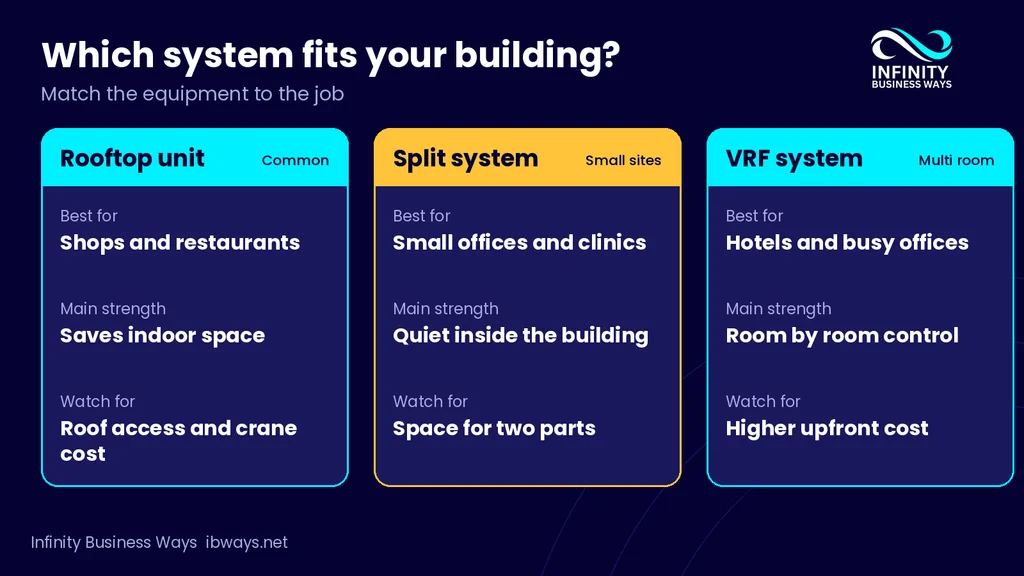
Rooftop units are the workhorse for shops, restaurants and small offices because they combine heating and cooling in one package. Heat pumps keep growing because one system does both jobs, but cold climates need a model rated for low temperatures and often a backup heat source.
VRF systems cost more upfront, yet they suit hotels and multi room offices because each room can hold its own setting. Chillers and boiler plants serve very large buildings and need trained operators and a strict maintenance plan.
If you are weighing electric heating, our guide to electric furnace installation cost covers pricing and a planning checklist.
How to Choose the Right System With the IB Ways Fit Check
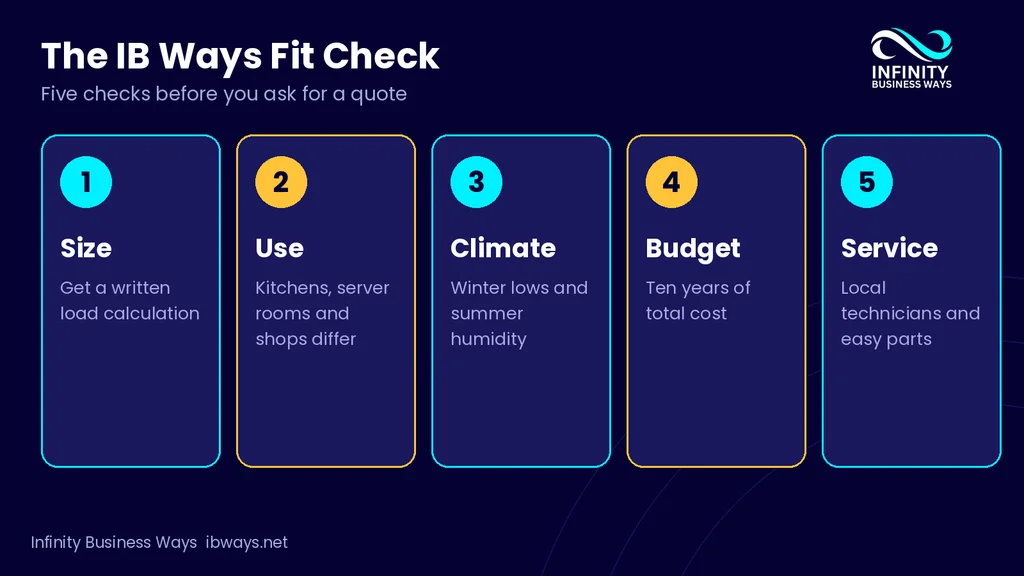
Use the IB Ways Fit Check, a five step test from Infinity Business Ways, before you ask for a single quote.
- Size. Ask for a written load calculation, not a square foot guess. It should count insulation, windows, ceiling height, people, lighting and equipment heat.
- Use. A kitchen, a server closet and a showroom each need different airflow and ventilation.
- Climate. Winter lows decide whether a heat pump needs backup heat. Summer humidity decides how much moisture control you need.
- Budget. Compare the upfront price with ten years of energy, upkeep and repair costs.
- Service. Pick equipment that local technicians know well and that has easy parts supply.
Example one. A 2,500 square foot restaurant has a hot kitchen and a busy dining room. It needs strong exhaust, matching make up air and separate control for each area. A rooftop unit paired with a dedicated make up air unit often fits this job.
Example two. A 20,000 square foot warehouse mostly needs heat near work areas. Unit heaters or radiant heaters, plus simple cooling for the office corner, can cost far less than ducting the whole building.
Commercial Heating and Cooling Cost in 2026
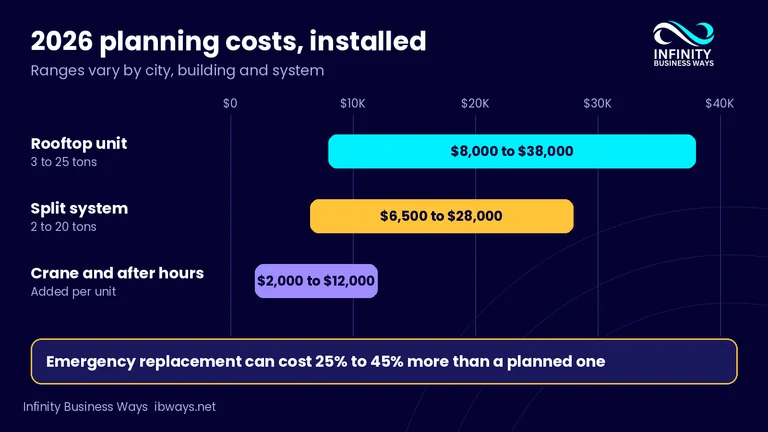
Prices change by city, building and system, so treat every number here as a planning range and not a quote. One 2026 cost benchmark puts installed packaged rooftop units of 3 to 25 tons at roughly $8,000 to $38,000 and commercial split systems of 2 to 20 tons at roughly $6,500 to $28,000.
The same source says crane and after hours work can add $2,000 to $12,000 per unit. It also says rushed emergency replacements can cost 25% to 45% more than planned ones. VRF systems and chiller plants usually cost more per ton and are priced by design.
These factors move your price the most.
- Tonnage and the load calculation
- System type and brand
- Roof access, crane use and curb work
- Ductwork repairs or changes
- Electrical upgrades (including electrical installations and codes)
- Controls and thermostats
- Permits and refrigerant type
- Local labor rates
Think about total cost and not only the install price. Add yearly energy, maintenance and repairs. Many equipment guides place the life of rooftop and split systems at 15 to 20 years, so a cheaper unit that wastes energy can cost more over time.
Ask three companies for itemized written quotes with the same scope, equipment details, warranty terms and extra charges. Equal scope is the only way to compare prices fairly.
Also ask about financing and leasing. Some providers offer payment plans or equipment leasing that spreads a large replacement across several years. Compare the total cost with the cash price and confirm who pays for repairs during the lease term. Tenants should check the lease first, because a landlord may need to approve work on rooftop equipment.
Commercial Heating and Cooling Services and How to Choose a Company
Most providers offer installation, repair, planned maintenance, emergency service, retrofits and indoor air quality work. Not every company does all of these well, so match the provider to your need.
| Your need | Provider type to look for | Ask this before hiring |
|---|---|---|
| Heating or cooling fails today | A local company with emergency service | What is your response time and after hours rate? |
| Steady upkeep | A company with planned maintenance agreements | What does each visit cover and will I get a report? |
| New or replacement system | A design and install contractor | Can you provide a written load calculation and warranty terms? |
| Lower energy bills | A contractor experienced in controls and retrofits | What savings did similar projects deliver? |
| Several locations | A regional or national service network | Can you offer one contract and one reporting system? |
For equipment and warranty questions, many owners also use a manufacturer dealer locator, such as the one on Carrier commercial HVAC, to find authorized installers. This is a starting point and not a ranking.
Before you sign, check these basics.
- A valid license and proof of insurance
- Technicians certified under EPA Section 608 for refrigerant work
- References from buildings like yours
- An itemized written quote
- Warranty terms for parts and labor
- Emergency response time in writing
When you search for commercial heating and cooling near me, add your city and the service you need, such as repair or maintenance. Confirm the company works on commercial equipment and not only homes. Read recent reviews on its Google Business Profile, then call and ask about service plans. We do not rank named companies here because the best choice depends on your need and location.
Commercial Heating and Cooling Repair Signs and What to Do
Searching for commercial HVAC repair is stressful when the building is too hot or too cold. Spot these warning signs early and you may avoid a full shutdown.
| Warning sign | Common cause | What to do |
|---|---|---|
| Uneven room temperatures | Blocked airflow, failing dampers or sensor faults | Check filters, then book an airflow test |
| Weak airflow from vents | Dirty filters or coils, or a failing fan | Replace filters and schedule an inspection |
| Grinding, squealing or rattling | Worn bearings, loose panels or a failing motor | Turn off the unit if it grinds and call a technician |
| Water around indoor equipment | Clogged condensate drain or a frozen coil | Clear the drain if safe, then request service |
| Rising energy bills | Dirty coils, low refrigerant or drifting controls | Compare bills with last year and book a tune up |
| Frequent on and off cycles | Oversized equipment, sensor or electrical faults | Request a diagnostic visit |
| Gas or burning smells | Gas leak or electrical overheating | Leave the area, then call your gas utility or emergency services |
Repair or replace.
Many facility teams start pricing a replacement when one repair costs about 40% to 50% of a new installed unit, or when the equipment is past 15 years old and fails often. Ask your provider for a written repair and replacement comparison so you can decide with real numbers.
Commercial Heating and Cooling Maintenance Checklist
Planned upkeep is the cheapest way to avoid breakdowns. A U.S. Department of Energy DOE maintenance estimates that operations and maintenance programs can save 5% to 20% on energy bills without major capital spending. The Standard 180 overview from DOE notes that ANSI/ASHRAE/ACCA Standard 180 sets minimum inspection and maintenance requirements for commercial HVAC systems.
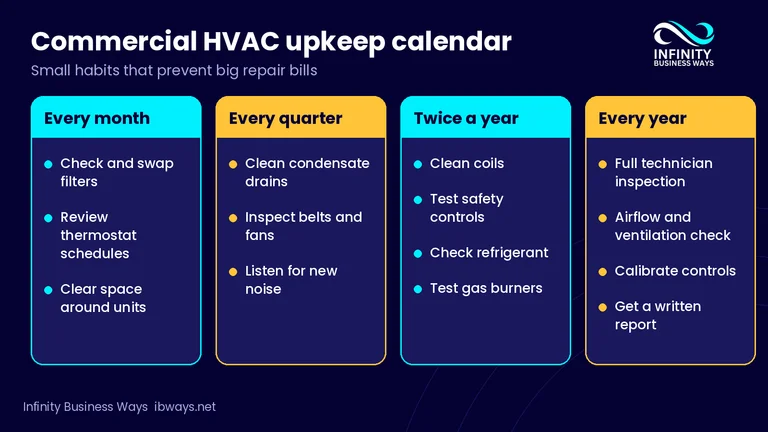
Every month. Check and replace filters, review thermostat schedules and keep space around units and air intakes clear.
Every quarter. Clean condensate drains, inspect belts and fans and listen for new noise or vibration.
Twice a year, before heating and cooling seasons. Clean coils, test safety controls, check refrigerant levels and look for leaks, test gas burners and heat exchangers and tighten electrical connections.
Every year. Book a full inspection by a licensed technician, check airflow and ventilation, calibrate controls and sensors and ask for a written report.
Keep a log of every visit and repair. A log helps you spot repeat problems and supports warranty claims.
A maintenance agreement can also give you priority service during heat waves and cold snaps, which are the busiest weeks for every provider. Ask whether the agreement includes parts, labor and emergency calls.
How to Make Commercial Heating and Cooling Systems More Efficient
Efficiency comes from many small habits and a few smart upgrades.
- Keep filters, coils and drains clean.
- Match thermostat schedules to real opening hours. The NREL energy saving checklist recommends programmable thermostats set to a seven day occupancy schedule.
- Right size equipment. Oversized units switch on and off too often and wear out faster.
- Seal and insulate ducts so conditioned air reaches the rooms that need it.
- Add economizers, which use cool outdoor air for free cooling when conditions allow.
- Consider energy recovery ventilators, which NREL also lists, to condition fresh air using exhaust air.
- Use variable speed fans and zoning so each area gets only what it needs.
- Cut heat gain with window film, shades and efficient lighting.
- Replace very old units, since newer models must meet higher efficiency minimums.
Common Mistakes to Avoid
- Sizing equipment by square footage alone instead of a load calculation.
- Picking the lowest quote without matching the scope of work.
- Skipping filter changes during busy seasons.
- Waiting for a full breakdown before calling for service.
- Ignoring the refrigerant type in a new equipment quote.
- Counting on the 179D deduction for a project that starts after June 30, 2026.
- Hiring a home only company for commercial equipment.
Rules, Refrigerants and Incentives to Check in 2026
Refrigerant changes
Federal rules under the AIM Act are moving the industry away from the older R410A refrigerant toward lower impact options such as R454B. According to this ACCA rule summary, EPA issued a final rule in May that lifted the January 1, 2026 installation ban for residential and light commercial R410A equipment made before 2025. VRF systems follow a later timeline that runs into 2027, and New York kept its own January 1, 2026 date.
The rule covers new equipment, so systems already in place can keep running. Ask any contractor which refrigerant your quoted unit uses and what future service may cost.
Tax deductions and rebates
Many older articles still promote the federal 179D deduction for energy efficient commercial buildings. The DOE 179D page states that the deduction does not apply to property whose construction begins after June 30, 2026. Projects that started on or before that date may still qualify. Check with a tax advisor before you count on it. Also ask your electric or gas utility about commercial rebates for high efficiency equipment, since programs differ by area.
Ventilation and permits
ASHRAE Standard 62.1 sets minimum ventilation rates that depend on how a space is used. This ASHRAE 62.1 overview explains the basics. Local codes decide which edition applies. Permits vary by city, so confirm that your contractor pulls them and books inspections.
Final Thoughts And FAQs of Commercial Heating and Cooling
Commercial heating and cooling works best when the system fits the building, upkeep is planned and the provider matches the job. Start with the IB Ways Fit Check, collect itemized quotes and set a maintenance schedule before the next season starts.
Small steps today cut breakdowns, reduce wasted energy and keep your business open and comfortable. Bookmark this guide and share it with any partner, manager or landlord who helps decide on equipment. Check back with Infinity Business Ways for more practical guides on running a local business.
FAQs
What is commercial heating and cooling?
Commercial heating and cooling is the HVAC equipment that controls temperature, airflow and humidity in business buildings. It includes heaters, air conditioners, heat pumps, fans, ducts, filters and controls sized for offices, shops, restaurants and warehouses.
How much does commercial heating and cooling cost?
One 2026 benchmark places installed rooftop units between about $8,000 and $38,000 for 3 to 25 tons, and split systems between about $6,500 and $28,000 for 2 to 20 tons. Crane work, ductwork and electrical upgrades can raise the total, so request itemized written quotes.
How long do commercial heating and cooling systems last?
Many rooftop and split systems last 15 to 20 years with regular maintenance. Harsh weather, poor airflow and skipped service can shorten that life.
What makes commercial heating and cooling systems efficient?
Clean filters and coils, correct sizing, sealed ducts, smart schedules, economizers and zoning all help. A U.S. Department of Energy guide estimates that operations and maintenance programs can save 5% to 20% on energy bills.
Is a commercial landlord responsible for heating and cooling?
It depends on the lease. Some landlords maintain building systems and pass costs to tenants, while other leases make the tenant responsible for equipment inside the space. Read your lease, ask the landlord in writing and get legal advice if there is a dispute.
How do I find commercial heating and cooling companies near me?
Search for the service and your city, confirm the company handles commercial equipment, read recent reviews and check licenses and insurance. Compare itemized quotes and ask about emergency response time before you sign.
How often should commercial HVAC be serviced?
Plan for service at least twice a year, before the heating season and before the cooling season, with filter checks every month. Busy sites such as restaurants may need more visits. ANSI/ASHRAE/ACCA Standard 180 sets minimum inspection and maintenance requirements.